A life in context
The person behind the prize
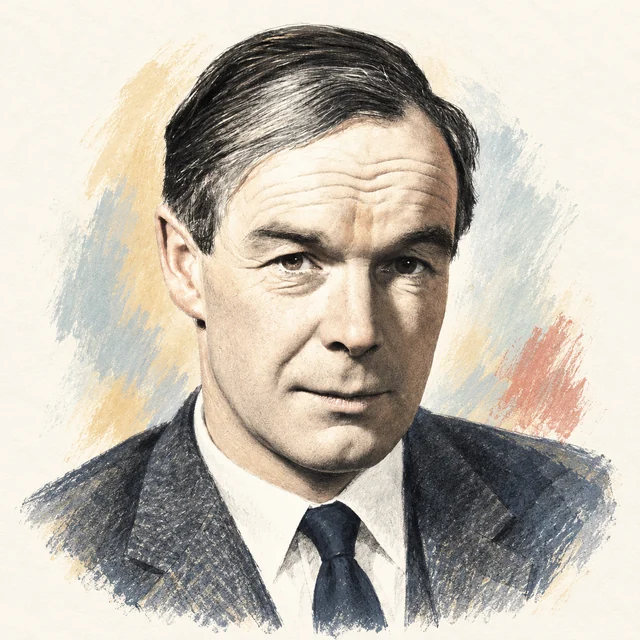
Hodgkin studied at Trinity College, Cambridge, in the 1930s and began research on nerve conduction. Work at Rockefeller in 1937–1938 included learning squid-axon methods with Kenneth Cole at Woods Hole. In 1939 he and Andrew Huxley recorded voltage from inside the squid giant axon at Plymouth. Wartime aviation medicine and radar work interrupted the research. Returning to Cambridge after the war, he worked with Huxley, Bernard Katz, Richard Keynes and others on ionic mechanisms. Voltage-clamp experiments distinguished sodium and potassium contributions; the 1952 model connected measurements with predictions of conduction and excitation. Cole’s earlier feedback apparatus was part of the technical background. Hodgkin became Foulerton Research Professor in 1951. Cambridge was his 1963 affiliation; later professorships, institutional leadership and knighthood were subsequent history.
The contribution
Hodgkin and Huxley explained nerve-impulse generation through membrane currents and a quantitative model. Hodgkin received one third of the Medicine Prize.
The idea in plain language
Nerves transmit impulses, but the changing electrical signal needed a physical explanation. Researchers also needed to distinguish the processes generating an impulse within an axon from the effects of signals arriving at synapses.
Read the full award story ↗