A life in context
The person behind the prize
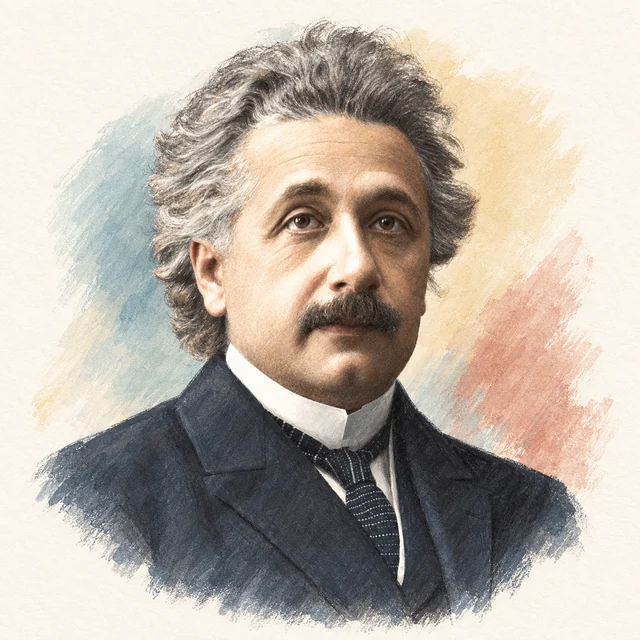
Einstein grew up in Munich and completed his studies at the Zurich Polytechnic in July 1900, as documented by ETH’s university archives. Work at the patent office in Bern gave him a livelihood while he developed several major contributions to physics. In 1905 he proposed that light could exchange energy in discrete quanta and used that idea to explain the photoelectric effect. The energy of a light quantum depends on frequency, helping explain why brightness alone cannot release electrons below a material’s threshold. His work also ranged across Brownian motion and relativity. Later academic posts took him to Zurich, Prague and Berlin. He became the first director of the Kaiser Wilhelm Institute for Physics when it was founded in 1917; that Berlin institution was his official affiliation for the Nobel award. The 1921 Physics Prize was reserved and awarded to him in 1922, recognising services to theoretical physics and especially the law of the photoelectric effect. It was not a prize specifically for relativity. After the Nazis took power, he emigrated to the United States in 1933 and worked at the Institute for Advanced Study in Princeton. He died in Princeton in 1955. His later scientific and public activities extend beyond the contribution singled out by this award.
The contribution
Einstein received the full Physics Prize for services to theoretical physics, especially discovering the law of the photoelectric effect. His light-quantum explanation related the energy available to an emitted electron to the frequency of the incident light.
The idea in plain language
Light can release electrons from a material, but brightness does not settle whether it happens. In the usual single-photon photoelectric effect, the light must have a high enough frequency for that material. Increasing the intensity of light below that threshold does not simply build up energy in one electron until it escapes.
Read the full award story ↗

