c.curionodeThe Nobel Archive

1921 · Physics

Light’s frequency sets the energy of its quanta

Einstein explained the photoelectric effect using discrete light quanta. The 1921 prize, awarded in 1922, singled out his law connecting light’s frequency with the energy available to emitted electrons.

Light quantaPhotoelectric effectFrequency threshold
1921Physics

Visual guide

The prize, pictured

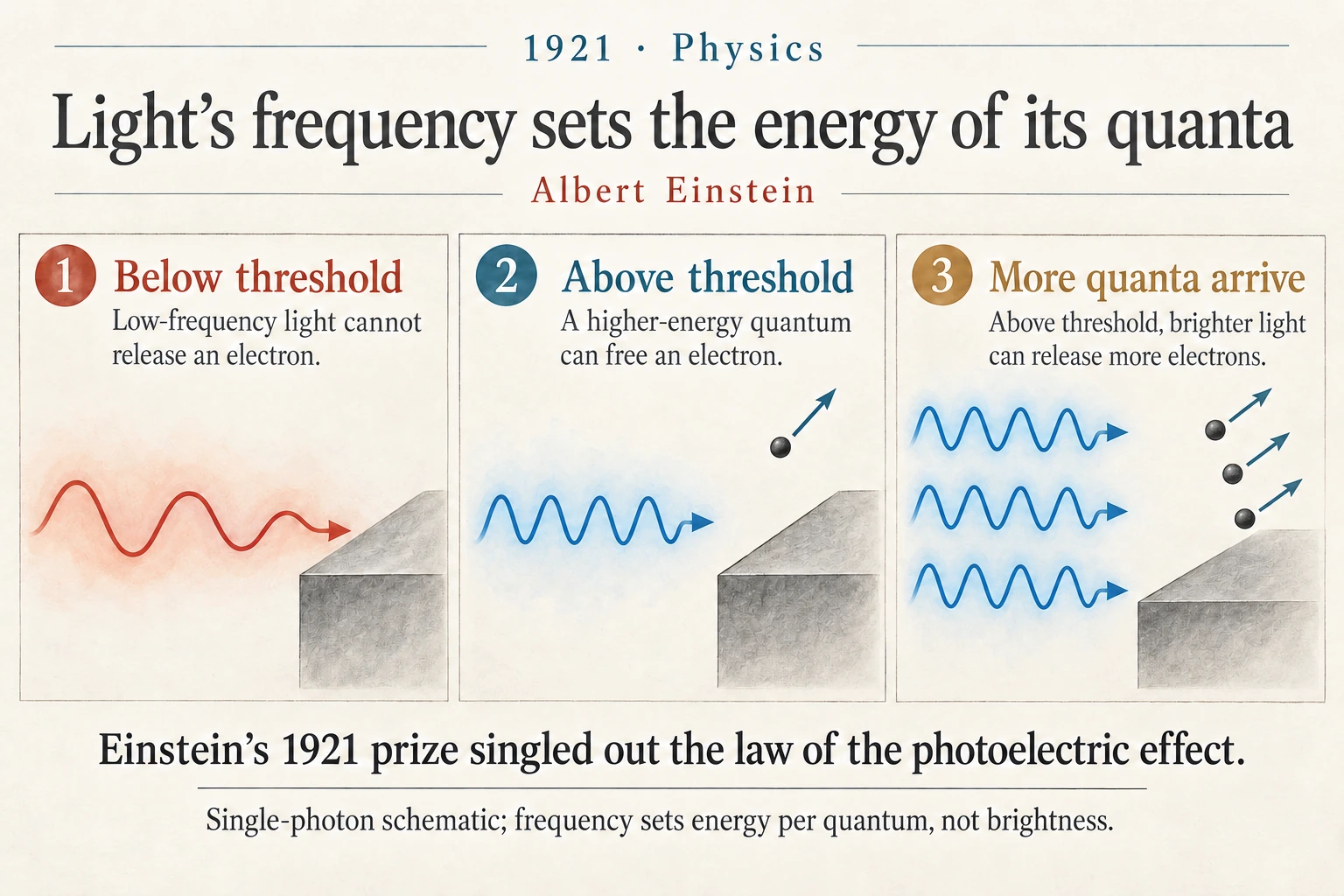
Infographic explaining Light’s frequency sets the energy of its quanta
Original AI-generated infographic. A conceptual overview; the explanations and sources below provide context.
Read the poster text

Einstein’s 1921 prize singled out the law of the photoelectric effect.

  1. Below threshold

    Low-frequency light cannot release an electron.

  2. Above threshold

    A higher-energy quantum can free an electron.

  3. More quanta arrive

    Above threshold, brighter light can release more electrons.

Single-photon schematic; frequency sets energy per quantum, not brightness.

01 · The discovery

The idea, in everyday language

Light can release electrons from a material, but brightness does not settle whether it happens. In the usual single-photon photoelectric effect, the light must have a high enough frequency for that material. Increasing the intensity of light below that threshold does not simply build up energy in one electron until it escapes.

In 1905 Einstein proposed that light exchanges energy in individual quanta. A quantum’s energy increases with frequency. Part of that energy is needed to free an electron; any remaining energy can become the emitted electron’s kinetic energy. Above threshold, brighter illumination can supply more quanta and therefore more emitted electrons, while their maximum energy is set by frequency and the material. The 1921 award was reserved and announced on 9 November 1922; the presentation followed on 10 December 1922.

Why it matters

The law provided a testable connection between light frequency and electron energy, making light’s exchange of energy a central problem in quantum physics. Millikan’s later precise measurements, recognised in the 1923 prize, tested this relationship. The 1921 citation covered services to theoretical physics, especially this law.
02 · The people

Who brought the idea to life?

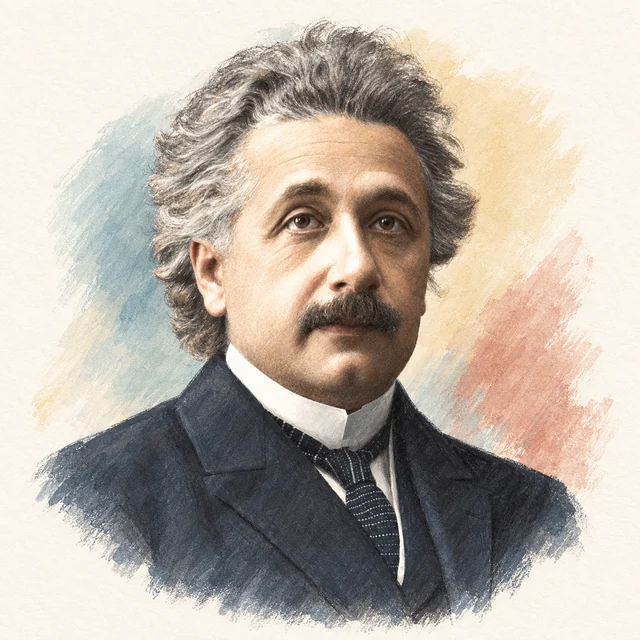
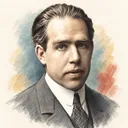
Illustrated portrait of Albert Einstein

Albert Einstein

Prize share · 1

Einstein received the full Physics Prize for services to theoretical physics, especially discovering the law of the photoelectric effect. His light-quantum explanation related the energy available to an emitted electron to the frequency of the incident light.

Read the biography ↗

03 · Years in the making

The path here

  1. 1900

    Einstein completes his Zurich Polytechnic studies in July.

  2. 1905

    He proposes light quanta and explains the photoelectric energy relation.

  3. 1917

    He becomes first director of the newly founded Kaiser Wilhelm Institute for Physics.

  4. 1921

    The Physics Prize is reserved.

  5. 1922

    The 1921 prize is announced in November and presented in December.

04 · Read further

From the original sources

Original explanations by Curionode, based on the official records below. Biographical details and affiliations refer to the award year.

  1. Official award summary nobelprize.org
  2. Award ceremony speech nobelprize.org
  3. ETH Library: Einstein’s studies library.ethz.ch
  4. Max Planck Institute for Physics: history mpp.mpg.de