A life in context
The person behind the prize
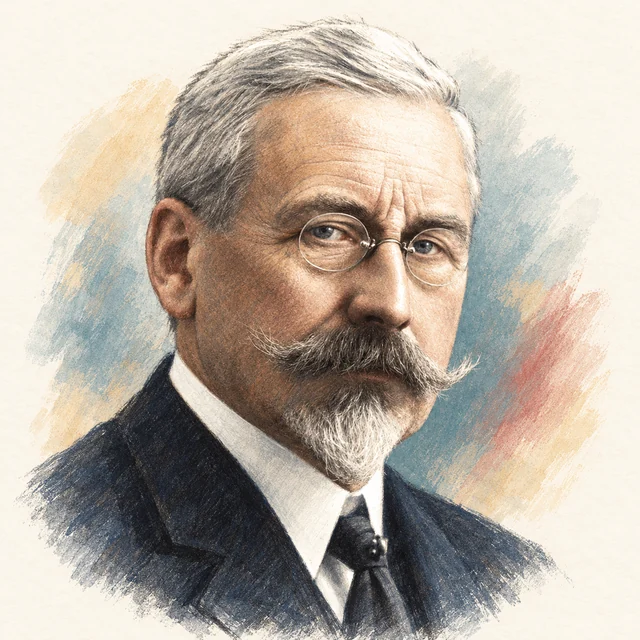
Guillaume grew up in Fleurier in the Swiss Jura, in a family connected with watchmaking. He studied in Zurich and joined the International Bureau of Weights and Measures in 1883. Early work concerned thermometry: reliable temperature readings and the expansion of length standards were closely connected problems. His systematic investigations of nickel–iron alloys revealed that their response to temperature depended strongly on composition. In 1896 he found Invar, an alloy with unusually small thermal expansion over a useful temperature range. Such stability helped surveyors and instrument makers reduce errors in measured lengths. His related alloy work also produced Elinvar, whose elastic stiffness changes little with temperature, useful in precision timekeeping. Low expansion and stable elasticity are different properties. He became associate director of the Bureau in 1902 and director in 1915, the position recorded at his Nobel award. The full 1920 Physics Prize recognised the service to precision measurement from his discoveries in nickel steels. He retired in 1936 and died in 1938. His work belongs to the history of material standards and instruments; it does not mean that today’s definition of the metre is an Invar bar.
The contribution
Guillaume received the full Physics Prize for discoveries about nickel-steel alloys that improved precision measurement. Invar’s unusually small thermal expansion and related investigations made more stable measuring instruments and length references possible.
The idea in plain language
A metal ruler can change length when its temperature changes. In careful measurement, that small change becomes part of the result rather than a harmless detail. Guillaume’s work at the International Bureau of Weights and Measures connected thermometry, material properties and the reliability of length references.
Read the full award story ↗

