A life in context
The person behind the prize
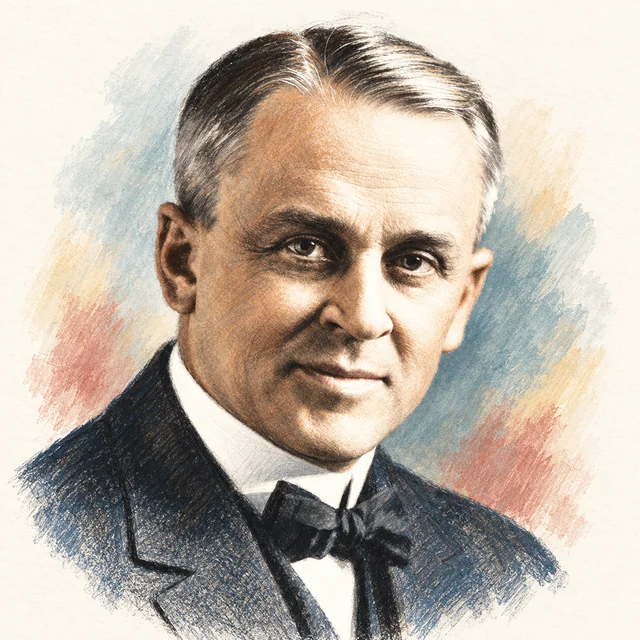
Millikan grew up in the American Midwest and studied at Oberlin, where Greek and mathematics were early interests. Teaching elementary physics helped turn his attention towards experimental science. He earned a doctorate at Columbia in 1895, studied in Berlin and Göttingen, and joined the University of Chicago in 1896. Alongside teaching and textbook writing, he developed exacting experiments on electrical charge. His oil-drop work measured how tiny charged drops moved under gravity and electrical forces, allowing a common unit of charge to be inferred from repeated observations. He also made independent measurements of the photoelectric effect, testing Einstein’s relation between light and emitted electrons. The full 1923 Physics Prize recognised both lines of work. His affiliation at the award was Caltech, where he had moved in 1921 to lead the Norman Bridge Laboratory and chair the institute’s executive council. He helped organise its research and later investigated cosmic radiation. Those later activities were separate from the experiments recognised in 1923. He died in San Marino, California, in 1953.
The contribution
Millikan received the full Physics Prize for work on the elementary electric charge and the photoelectric effect. His precise oil-drop measurements and tests of Einstein’s photoelectric law provided two distinct kinds of experimental evidence.
The idea in plain language
How could the size of an elementary electric charge be measured? Millikan studied tiny charged oil drops between metal plates. By comparing their motion under gravity and electrical forces, and observing changes when a drop gained or lost charge, he could infer a common unit. The drops carried charge; the experiment did not show individual electrons as visible balls.
Read the full award story ↗

