A life in context
The person behind the prize
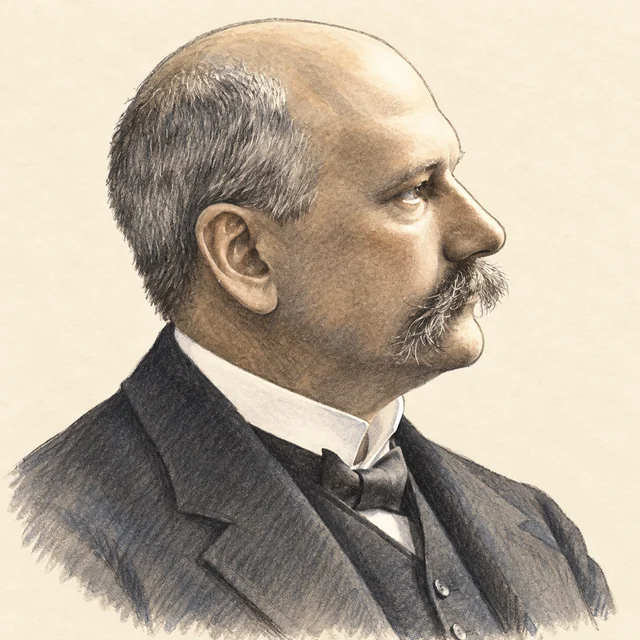
Albrecht Kossel studied medicine in Strasbourg and Rostock, passing the state examination in 1877 and receiving his medical doctorate in 1878. Work with Felix Hoppe-Seyler drew him into physiological chemistry and the composition of cells. He qualified as a lecturer in 1881, moved to Berlin’s Institute of Physiology in 1883 and became an extraordinary professor in 1887. A chair in Marburg followed in 1895, then Heidelberg in 1901, his institution at the time of the Nobel Prize. Kossel investigated the constituents obtained from nucleic substances and the proteins associated with them, including histones and protamines. His work on basic amino acids included the discovery of histidine in 1896; these protein building blocks must be distinguished from nucleic-acid bases. Together with pupils and collaborators, he developed analytical methods for comparing composition rather than relying only on how a cell looked under a microscope. The full 1910 Physiology or Medicine Prize recognised this contribution to cell chemistry. He also taught physiology, edited a major physiological chemistry journal and advocated separate academic provision for medical chemistry. He died in Heidelberg in 1927. Later work established the structures and genetic roles of nucleic acids; his award did not announce the DNA double helix or the genetic code.
The contribution
Kossel received the full Medicine Prize for contributions to cell chemistry through research on proteins and nucleic substances. Identifying their different components and quantitative relationships helped make the cell’s material composition experimentally accessible.
The idea in plain language
Seeing a nucleus under a microscope does not establish what its material is made of. Kossel investigated substances isolated from cells, distinguishing and characterising components through chemistry. His work included nucleic-acid constituents and proteins such as histones and protamines, rather than treating all nuclear material as one substance.
Read the full award story ↗

