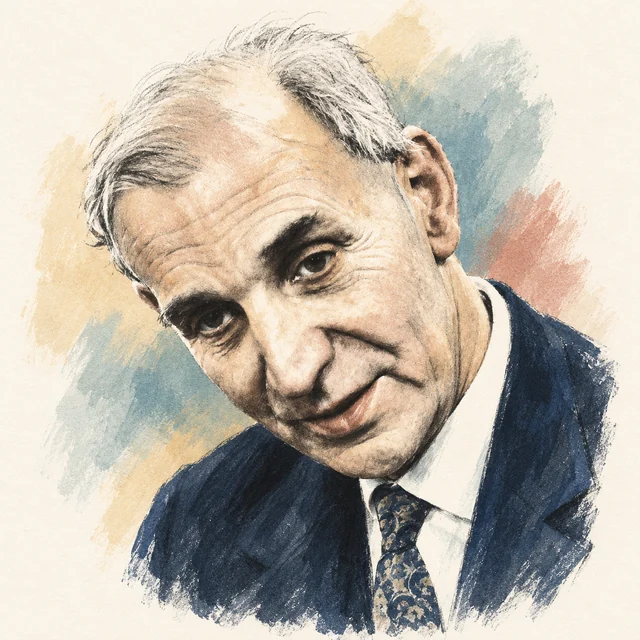
A life in context
The person behind the prize
Kastler entered the École Normale Supérieure in 1921 and began teaching in secondary schools after leaving in 1926. From 1931 he worked at Bordeaux, then Clermont-Ferrand, becoming professor at Bordeaux in 1938. In 1941 Georges Bruhat brought him to Paris to help develop physics teaching; a personal university chair followed in 1952. His research on fluorescence, polarization and spectroscopy led toward optical studies of atomic resonances. With Jean Brossel, he developed double-resonance methods linking optical observations to radio-frequency or microwave transitions. In 1950 he proposed optical pumping, which redistributes populations among atomic sublevels through selective light absorption and subsequent emission. Brossel, Kastler and Winter performed the experiment in 1952. The Paris team’s work enabled sensitive measurements of atomic properties; the award recognised these optical methods, with the École Normale Supérieure as his affiliation.
The contribution
Kastler discovered and developed optical methods for studying atomic resonances. He received the full Physics Prize.
The idea in plain language
Atoms have energy levels with finer sublevels whose populations and transitions reveal magnetic properties. Kastler and collaborators combined optical observations with radio-frequency or microwave resonance. Light provided a sensitive way to detect changes that were difficult to measure directly.
Read the full award story ↗

