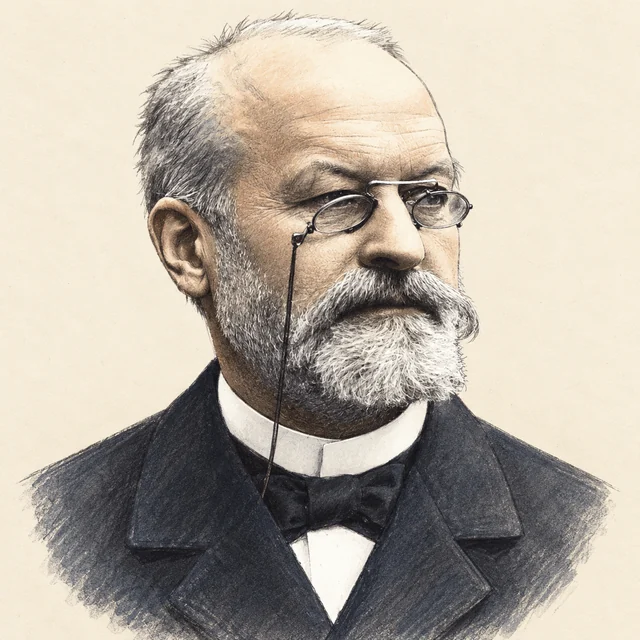
A life in context
The person behind the prize
Charles Louis Alphonse Laveran followed his father into military medicine. He studied in Strasbourg from 1863, completed his medical doctorate in 1867 and served during the Franco-Prussian War. Teaching at the Val-de-Grâce was followed by military medical work in Algeria from 1878, within the French colonial system. At Constantine in 1880 he examined blood from patients with malaria and observed pigmented bodies and active thread-like structures that persuaded him a parasite was involved. Many colleagues were sceptical: explanations based on bad air or bacteria remained influential. Repeated observations and publications helped establish a protozoan cause. The discovery belongs to 1880, rather than the later date of 1889 sometimes given in brief accounts. After further military appointments he joined the Institut Pasteur and devoted himself to parasitology. With Félix Mesnil he studied trypanosomes and published a treatise in 1904, extending the investigation of protozoa as agents of human and animal disease. The work formed part of a wider international effort; Laveran did not alone discover every parasite or establish the whole mosquito transmission cycle of malaria. He received the full 1907 Medicine Prize for the role played by protozoa in causing diseases. He supported facilities for parasitology at the Institut Pasteur and helped establish the Société de pathologie exotique in 1908. That learned society should not be confused with the institute itself. He continued researching and writing until his death in Paris in 1922. His work changed how disease could be investigated: the search for a cause could include microscopic parasites inside blood cells, while identifying an organism remained only one step towards understanding its life cycle and controlling infection.
The contribution
Laveran received the full Medicine Prize for work on protozoa as causes of disease, including the malaria parasite observed in blood in 1880 and subsequent parasitological research.
The idea in plain language
At Constantine in 1880 Laveran examined patients’ blood and observed pigmented bodies and moving structures associated with malaria. These observations, repeated and defended against scepticism, helped establish that an animal-like microscopic parasite could cause an important human disease. In modern terms malaria is caused by Plasmodium parasites, not bacteria or viruses.
Read the full award story ↗

