c.curionodeThe Nobel Archive

1907 · Physiology or Medicine

Find disease-causing parasites in the microscopic world

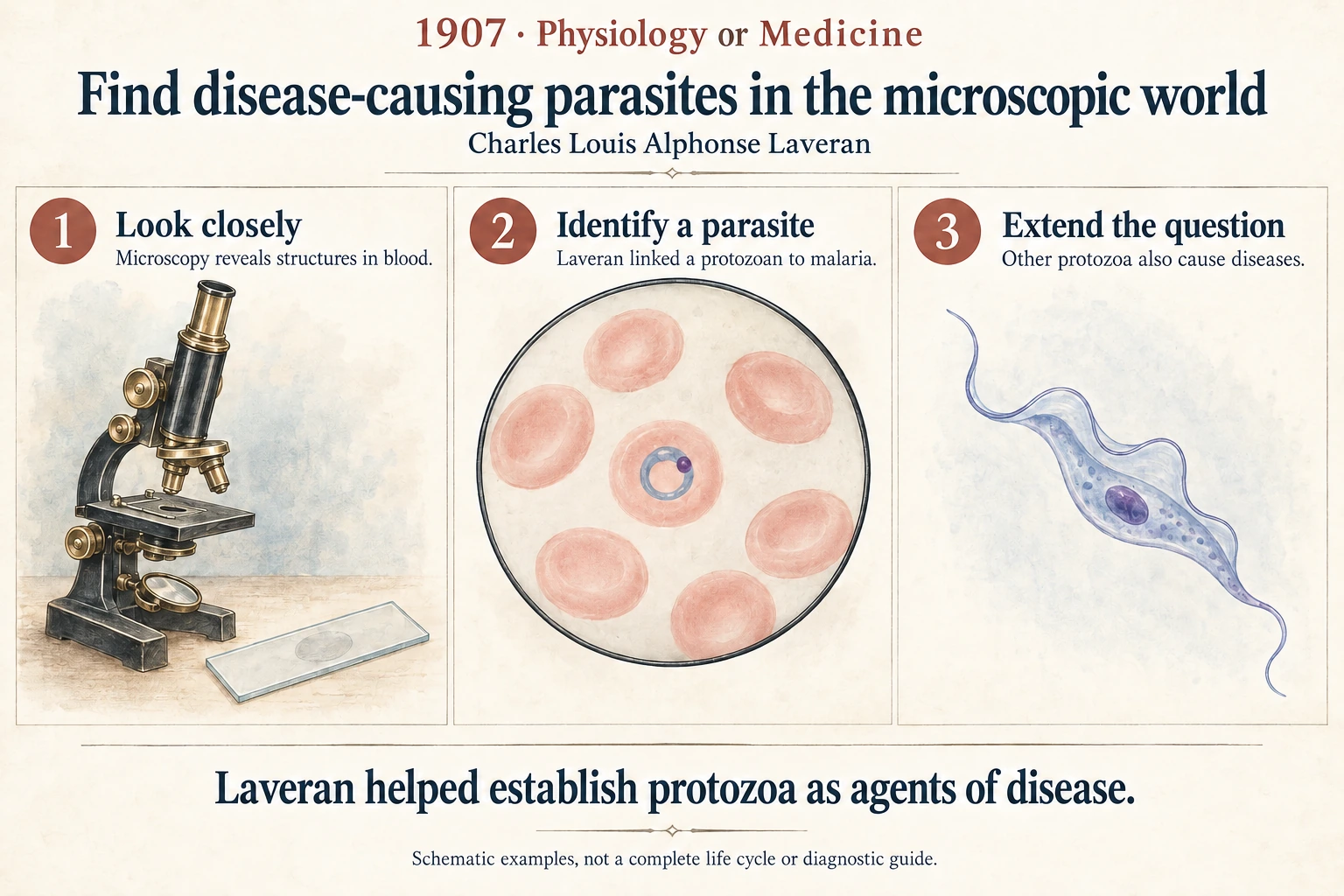
What caused recurring malarial fever? Laveran’s observations helped show that a microscopic protozoan parasite, rather than bad air, was involved, opening a wider study of protozoa as causes of disease.

ProtozoaMalariaParasitology
1907Physiology or Medicine

Visual guide

The prize, pictured

Infographic explaining Find disease-causing parasites in the microscopic world
Original AI-generated infographic. A conceptual overview; the explanations and sources below provide context.
Read the poster text

Laveran helped establish protozoa as agents of disease.

  1. Look closely

    Microscopy reveals structures in blood.

  2. Identify a parasite

    Laveran linked a protozoan to malaria.

  3. Extend the question

    Other protozoa also cause diseases.

Schematic examples, not a complete life cycle or diagnostic guide.

01 · The discovery

The idea, in everyday language

At Constantine in 1880 Laveran examined patients’ blood and observed pigmented bodies and moving structures associated with malaria. These observations, repeated and defended against scepticism, helped establish that an animal-like microscopic parasite could cause an important human disease. In modern terms malaria is caused by Plasmodium parasites, not bacteria or viruses.

His later work extended to other protozoa, including research on trypanosomes with Félix Mesnil. The 1907 prize recognised this broader contribution. Identifying the parasite must be distinguished from establishing the full life cycle and mosquito transmission, which involved other investigators, including the work recognised by Ronald Ross’s 1902 prize.

Why it matters

The work widened the search for infectious causes beyond bacteria and encouraged systematic parasitology. Linking specific parasites to disease made new questions about life cycles, transmission and prevention experimentally approachable.
02 · The people

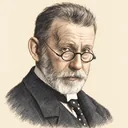
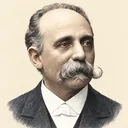
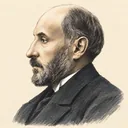
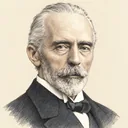
Who brought the idea to life?

03 · Years in the making

The path here

  1. 1867

    Laveran completes his medical doctorate in Strasbourg.

  2. 1878

    Military medical work takes him to Algeria.

  3. 1880

    He observes the malaria parasite in patients’ blood at Constantine.

  4. 1884

    He publishes a treatise on malarial fevers.

  5. 1904

    Laveran and Mesnil publish their treatise on trypanosomes.

  6. 1907

    The Medicine Prize recognises work on disease-causing protozoa.

  7. 1908

    He helps establish the Société de pathologie exotique.

04 · Read further

From the original sources

Original explanations by Curionode, based on the official records below. Biographical details and affiliations refer to the award year.

  1. Official award summary nobelprize.org
  2. Prepared award presentation nobelprize.org
  3. Institut Pasteur: Laveran, Mesnil and disease-causing protozoa pasteur.fr

More in Physiology or Medicine

Browse this subject ↗