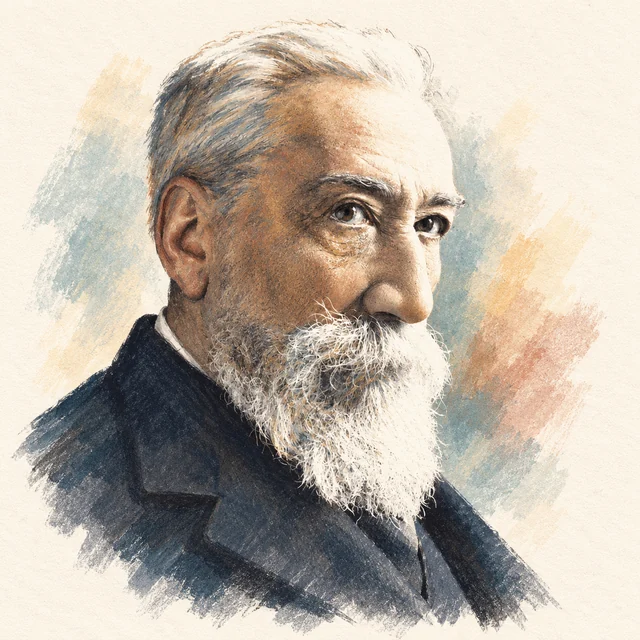
A life in context
The person behind the prize
France grew up in Paris among books: his father ran a bookshop with a particular interest in the French Revolution. After studying at Collège Stanislas, he worked in that literary setting and began writing poetry, journalism and criticism. He was a librarian for the French Senate from 1876 to 1890 and later a literary critic for Le Temps. Le Crime de Sylvestre Bonnard brought a major success in 1881. His fiction combined an elegant, lucid style with sympathy for human frailty and skepticism towards confident claims to authority. Works before the Nobel award included Thaïs (1890), La Rôtisserie de la Reine Pédauque (1893), Les Dieux ont soif (1912) and La Révolte des anges (1914). He entered the Académie française in 1896 and supported the campaign on behalf of Dreyfus, bringing political and social concerns into his public life and writing. The First World War deepened his pessimism, while Le Petit Pierre (1918) returned to childhood memory. The full 1921 Literature Prize recognised his broad literary achievement rather than one novel. France was his award-time residence, not a university affiliation; he wrote in French. He died in Saint-Cyr-sur-Loire in 1924.
The contribution
France received the full Literature Prize for literary achievement marked by style and deep human sympathy. Fiction, criticism and irony brought vulnerable individuals into tension with dogma, institutions and the certainty of those who exercise power.
The idea in plain language
What happens when a confident doctrine meets the untidy needs of an individual? France’s fiction repeatedly places ideas, institutions and claims to moral certainty beside people who are fallible or vulnerable. A lucid narrative voice and controlled irony invite readers to notice the gap.
Read the full award story ↗

