A life in context
The person behind the prize
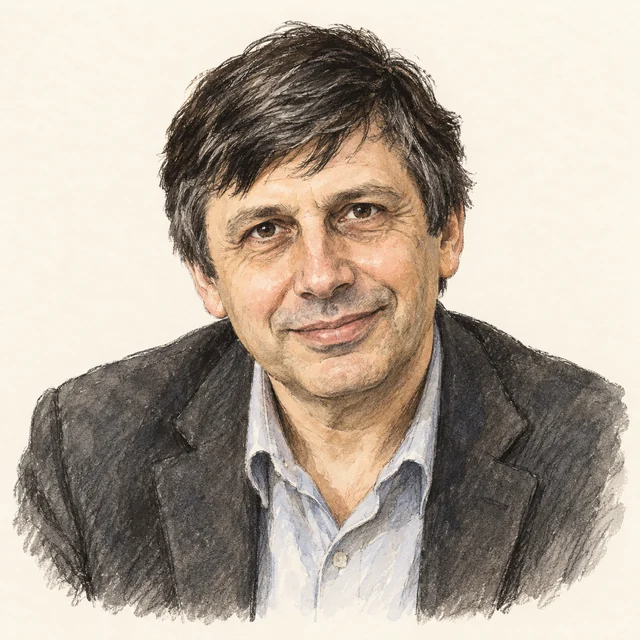
Geim trained in physics in the Soviet Union and earned his doctorate in 1987. His research career took him through several European laboratories and a position in the Netherlands before he moved to Manchester in 2001. He encouraged exploratory experiments that could begin with an apparently simple question. His collaboration with Konstantin Novoselov combined this approach with the careful preparation and measurement of extremely thin materials.
The contribution
Geim and Novoselov isolated and investigated graphene: a sheet of carbon only one atom thick. Their team used adhesive tape to separate thin flakes from graphite, identified single layers on a suitable substrate and measured their electronic properties. The important achievement was making this two-dimensional material accessible to controlled experiments, not inventing carbon or discovering that graphite contains layers.
The idea in plain language
Graphite, the material in a pencil, consists of many carbon sheets stacked together. Inside each sheet, carbon atoms form a strongly bonded honeycomb network; the attraction between neighbouring sheets is much weaker. Geim and Novoselov’s team peeled graphite into thin flakes, identified single layers on a suitable surface and attached electrical contacts. In 2004 they reported experiments on atomically thin carbon films.
Read the full award story ↗