c.curionodeThe Nobel Archive

2010 · Physics

A sheet of carbon one atom thick

A simple peeling technique opened an experimental world of two-dimensional materials.

graphenecarbontwo-dimensional materials
2010Physics

Visual guide

The prize, pictured

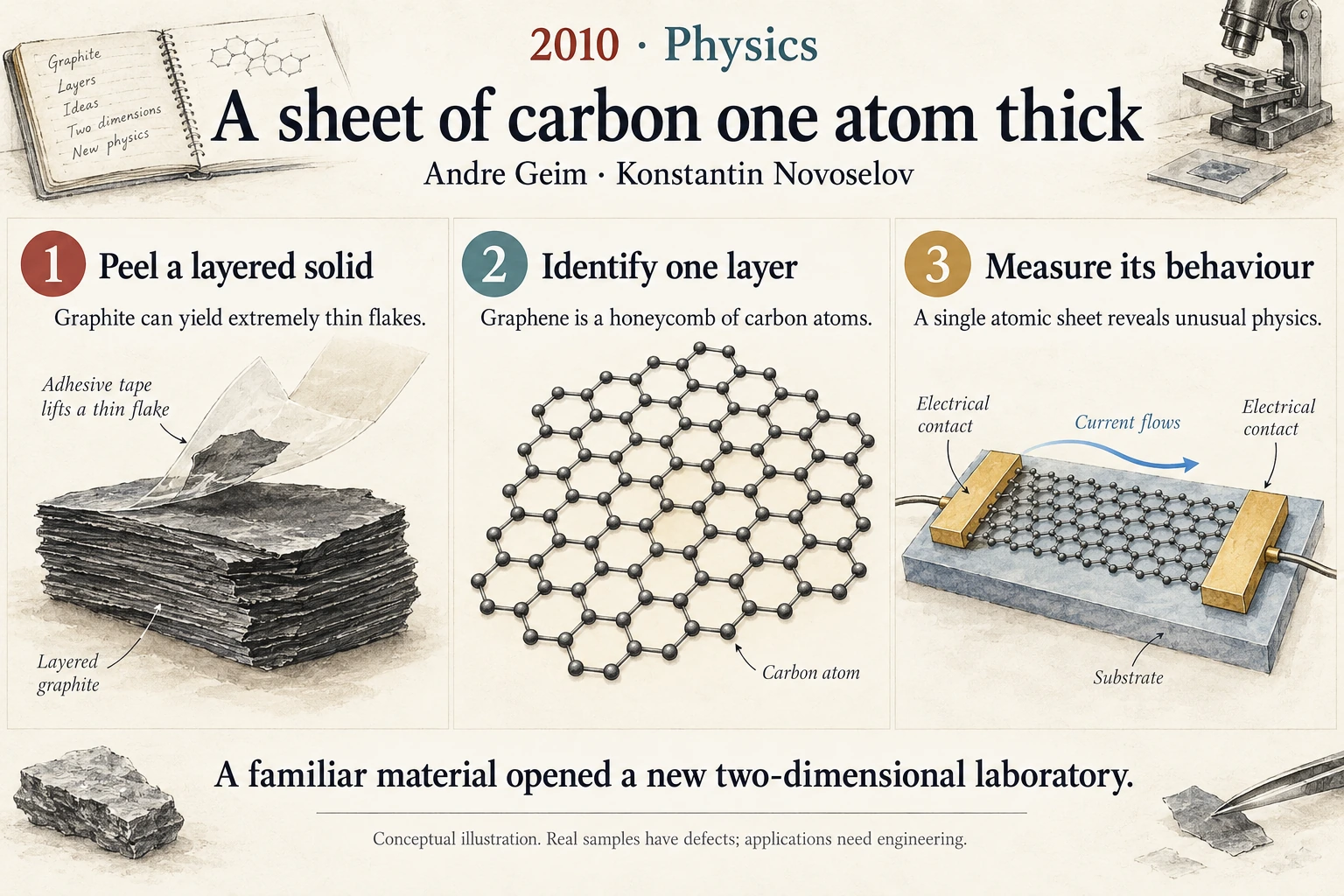
Infographic explaining A sheet of carbon one atom thick
Original AI-generated infographic. A conceptual overview; the explanations and sources below provide context.
Read the poster text

A familiar material opened a new two-dimensional laboratory.

  1. Peel a layered solid

    Graphite can yield extremely thin flakes.

  2. Identify one layer

    Graphene is a honeycomb of carbon atoms.

  3. Measure its behaviour

    A single atomic sheet reveals unusual physics.

Conceptual illustration. Real samples have defects; applications need engineering.

01 · The discovery

The idea, in everyday language

Graphite, the material in a pencil, consists of many carbon sheets stacked together. Inside each sheet, carbon atoms form a strongly bonded honeycomb network; the attraction between neighbouring sheets is much weaker. Geim and Novoselov’s team peeled graphite into thin flakes, identified single layers on a suitable surface and attached electrical contacts. In 2004 they reported experiments on atomically thin carbon films.

The single layer, graphene, was much more than a thinner piece of an ordinary solid. Its electronic structure lets charge carriers behave in ways described by equations resembling those for massless particles. Measuring the material provided a tabletop setting for unusual quantum effects and launched a much broader search for useful atomically thin materials. The electrons themselves do not lose their fundamental rest mass or move at the speed of light.

Why it matters

The experiments gave researchers a new material platform for studying electronic transport, mechanical strength and light–matter interactions. They also inspired work on sensors, conductive films, composites and other two-dimensional crystals. Turning a striking laboratory property into a reliable product requires control over defects, interfaces, manufacturing and cost.


02 · The people

Who brought the idea to life?

Illustrated portrait of Andre Geim

Andre Geim

Prize share · 1/2

Geim and Novoselov isolated and investigated graphene: a sheet of carbon only one atom thick. Their team used adhesive tape to separate thin flakes from graphite, identified single layers on a suitable substrate and measured their electronic properties. The important achievement was making this two-dimensional material accessible to controlled experiments, not inventing carbon or discovering that graphite contains layers.

Read the biography ↗
Illustrated portrait of Konstantin Novoselov

Konstantin Novoselov

Prize share · 1/2

Novoselov was central to the experiments on graphene reported in 2004 and the studies that followed. Finding a monolayer was only part of the task: the researchers also had to contact it electrically and establish its unusual transport properties. The work opened a practical route to studying two-dimensional materials and quantum phenomena in ordinary laboratory equipment.

Read the biography ↗

03 · Years in the making

The path here

  1. 2004

    The Manchester-led team reported electrical measurements on atomically thin carbon films.

  2. 2005

    Further experiments revealed unusual quantum transport in graphene.

  3. 2010

    Geim and Novoselov received the Physics Prize for graphene experiments.

04 · Read further

From the original sources

Original explanations by Curionode, based on the official records below. Biographical details and affiliations refer to the award year.

  1. Official announcement nobelprize.org
  2. Popular science background nobelprize.org
  3. Research paper: quantum transport in graphene nature.com