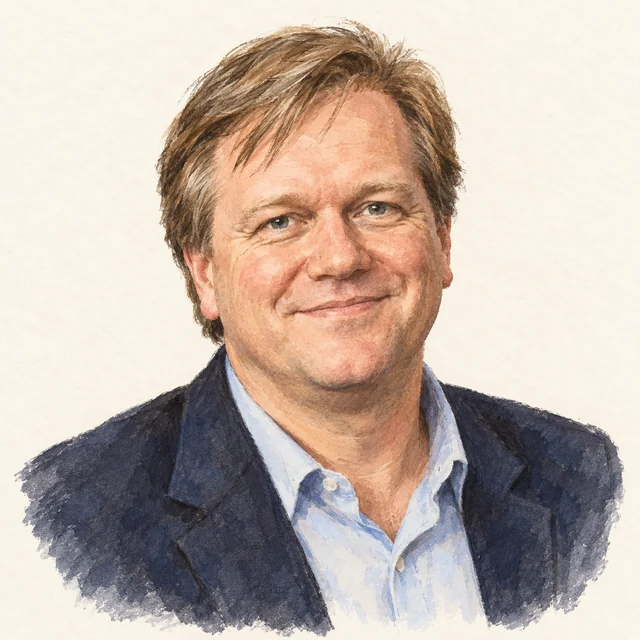
A life in context
The person behind the prize
Schmidt grew up in Montana and Alaska and received his doctorate from Harvard in 1993. He moved to Australia in 1994 and helped organise the High-Z Supernova Search Team. Based at the Australian National University during the prize-winning work, he coordinated an international effort combining telescopes, repeated brightness measurements and analysis of distant explosions.
The contribution
Schmidt led the High-Z team, whose results provided independent evidence for an accelerating universe. The project brought together specialists who could identify suitable supernovae, measure their evolving light and compare distances with redshifts. Its agreement with the competing Supernova Cosmology Project made the unexpected conclusion more compelling.
The idea in plain language
To ask how the universe expands, astronomers need both a measure of distance and a record of how much space has stretched since light began its journey. Type Ia supernovae provided unusually bright distance markers. They are not identical bulbs: researchers calibrated their brightness using the way their light changed with time and colour. Comparing this estimated intrinsic brightness with the light reaching Earth gave a distance estimate.
Read the full award story ↗