c.curionodeThe Nobel Archive

2009 · Physics

Guiding light, recording images

Two distinct breakthroughs helped information travel farther and images become electronic.

optical fibreCCDdigital imaging
2009Physics

Visual guide

The prize, pictured

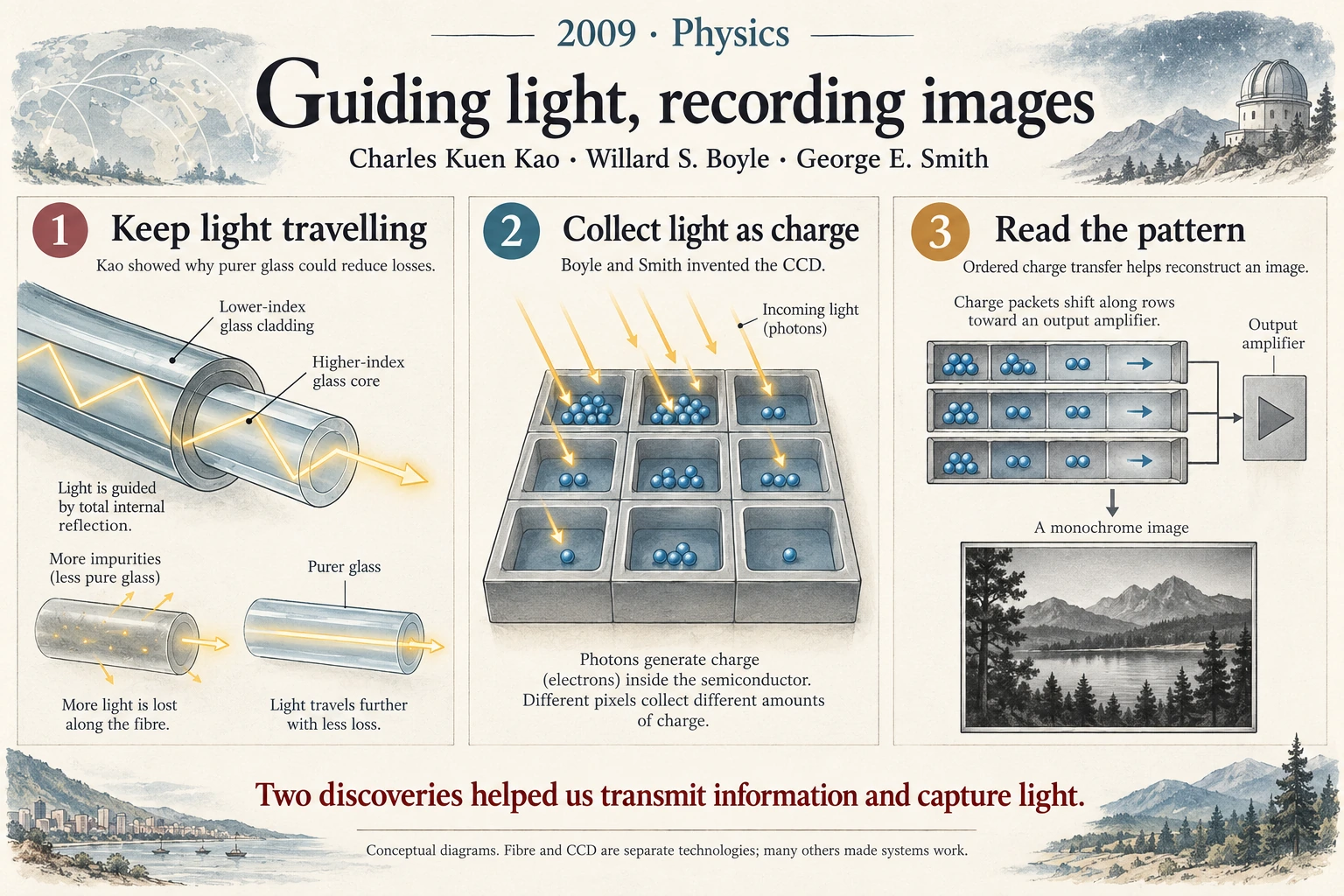
Infographic explaining Guiding light, recording images
Original AI-generated infographic. A conceptual overview; the explanations and sources below provide context.
Read the poster text

Two discoveries helped us transmit information and capture light.

  1. Keep light travelling

    Kao showed why purer glass could reduce losses.

  2. Collect light as charge

    Boyle and Smith invented the CCD.

  3. Read the pattern

    Ordered charge transfer helps reconstruct an image.

Conceptual diagrams. Fibre and CCD are separate technologies; many others made systems work.

01 · The discovery

The idea, in everyday language

A glass fibre can guide light, but early fibres lost too much of it to carry useful signals over long distances. Kao, working with George Hockham, showed that much of the obstacle came from impurities in the glass. His analysis pointed toward exceptionally pure material and helped turn optical communication into a practical research target. Making low-loss fibres, lasers, amplifiers and complete networks required many further contributors.

Boyle and Smith’s contribution was different: the charge-coupled device, or CCD. Light falling on a semiconductor generates electrical charge. A sensor stores that charge at many positions and transfers the packets in an ordered sequence to an output. Measuring them reconstructs the pattern of brightness across the image. The two achievements meet in modern information systems, but the optical fibre and CCD are separate inventions.

Why it matters

Low-loss optical fibres became a foundation of high-capacity communication. CCDs enabled sensitive electronic imaging in cameras, astronomy and other scientific instruments. Together with many other technologies, these advances made it easier to capture, process and transmit visual information.
02 · The people

Who brought the idea to life?

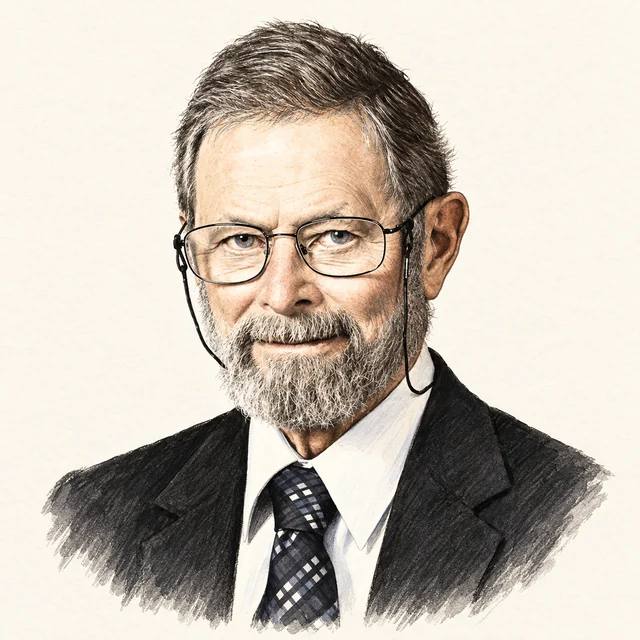
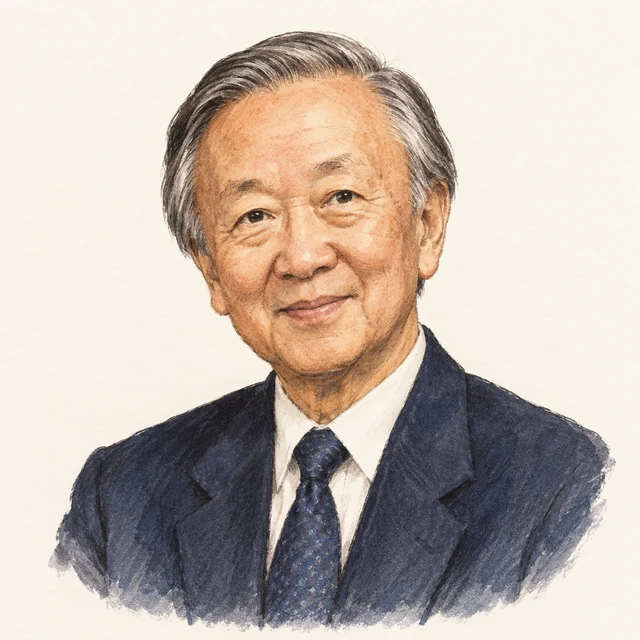
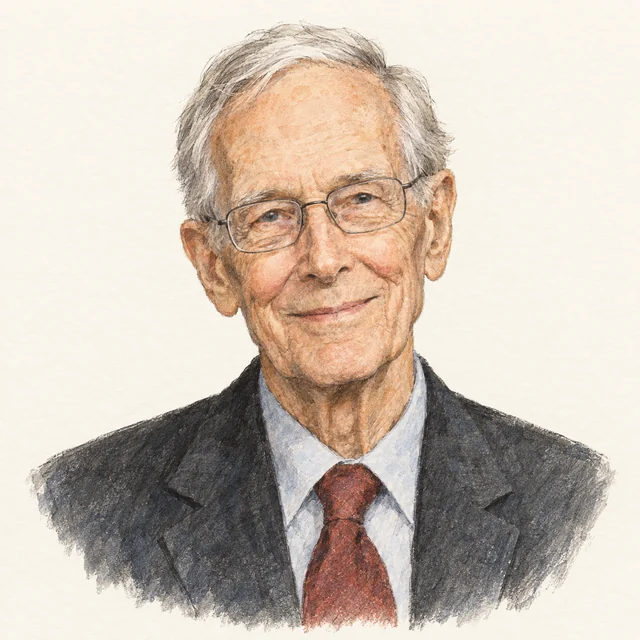
Illustrated portrait of Charles Kuen Kao

Charles Kuen Kao

Prize share · 1/2

Working with George Hockham, Kao showed that the severe losses in existing glass fibres were not an unavoidable barrier to communication. Much purer glass could make long-distance optical transmission practical. His 1966 analysis helped guide later materials research, including low-loss fibre made by a Corning team in 1970. He did not invent every part of fibre optics or personally manufacture the whole communication network.

Read the biography ↗
Illustrated portrait of Willard S. Boyle

Willard S. Boyle

Prize share · 1/4

Boyle and Smith invented the charge-coupled device, or CCD. When adapted to imaging, a grid of light-sensitive regions collects charge related to the light falling on it. Controlled voltages move those charge packets toward an output for measurement. This made a powerful electronic image sensor possible and contributed to digital photography and scientific imaging.

Read the biography ↗
Illustrated portrait of George E. Smith

George E. Smith

Prize share · 1/4

Smith shared the invention of a device that could transfer charge through an array in a controlled sequence. In a CCD image sensor, the amount of charge at each position records light intensity, and the ordered readout preserves the spatial pattern. Other researchers and engineers helped develop this principle into working cameras and sensitive instruments; a CCD is one sensor technology, not a synonym for every digital camera.

Read the biography ↗

03 · Years in the making

The path here

  1. 1966

    Kao and Hockham identified a route toward practical low-loss optical communication.

  2. 1969

    Boyle and Smith developed the charge-coupled-device concept at Bell Labs.

  3. 1970

    A Corning team produced a low-loss optical fibre, advancing Kao’s vision.

04 · Read further

From the original sources

Original explanations by Curionode, based on the official records below. Biographical details and affiliations refer to the award year.

  1. Official announcement nobelprize.org
  2. Popular science background nobelprize.org
  3. Corning: the 1970 low-loss fibre corning.com