01 · The discovery
The idea, in everyday language
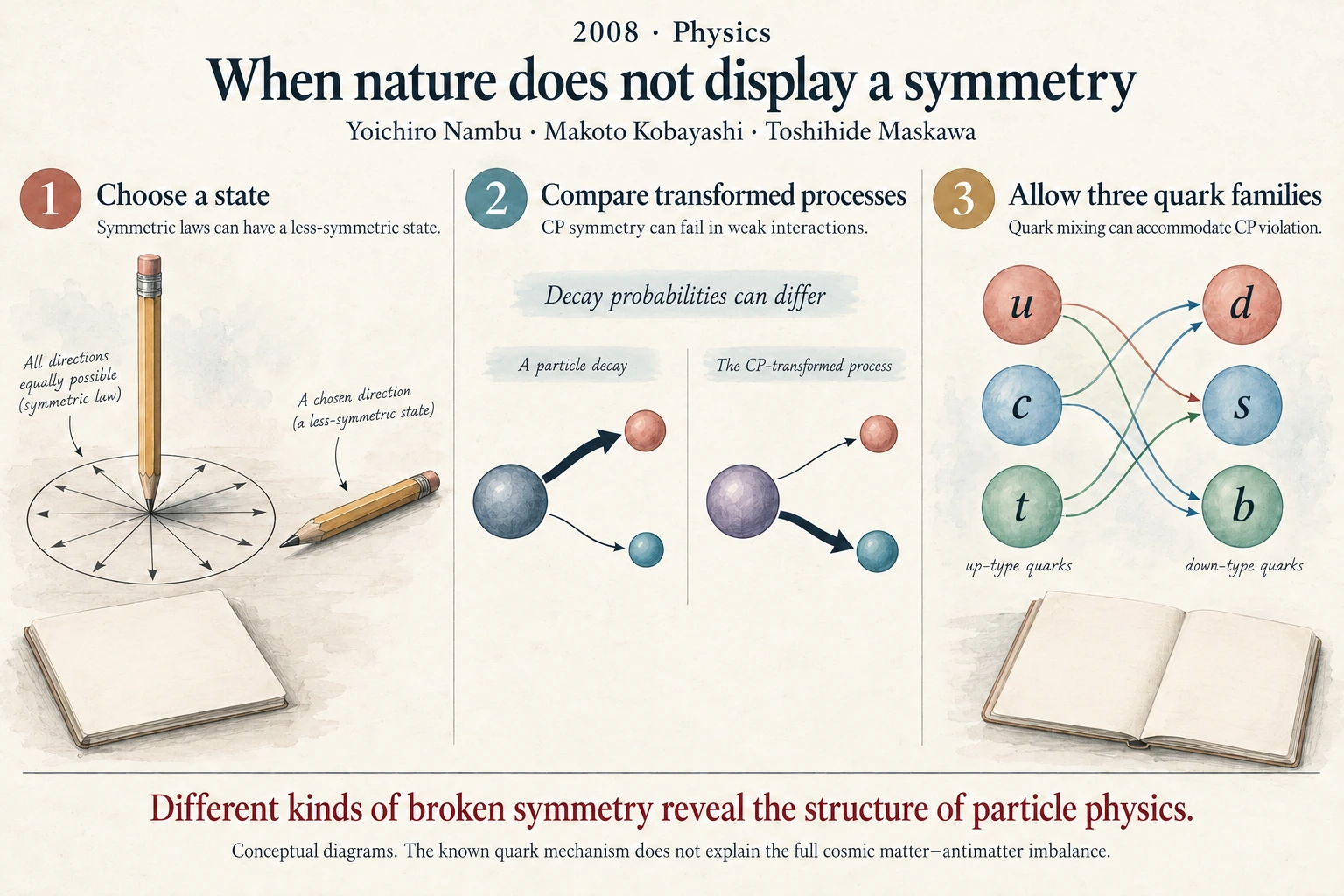
Nambu studied spontaneous symmetry breaking. A system’s equations can treat several possibilities equally, while its lowest-energy state selects one of them. Drawing on ideas from superconductivity, he brought this distinction into subatomic physics. The apparently less-symmetric state does not mean the original equations have been rewritten. His methods became fundamental to the description of particles and their interactions.
Kobayashi and Maskawa addressed a different issue: CP violation. CP combines replacing particles with antiparticles and reversing spatial directions as in a mirror. Some weak-interaction processes do not behave identically under that combined change. Their quark-mixing theory could accommodate this asymmetry with three families of quarks, giving a framework that later experiments tested.
Why it matters
These ideas helped organise the Standard Model and connect mathematical principles with measurable particle behaviour. The three-family quark framework acquired support from the discovery of additional quarks and from precision studies of decays, including the Belle and BaBar experiments. Nambu’s work supplied a broader language for understanding the relation between symmetries, states and interactions.