01 · The discovery
The idea, in everyday language
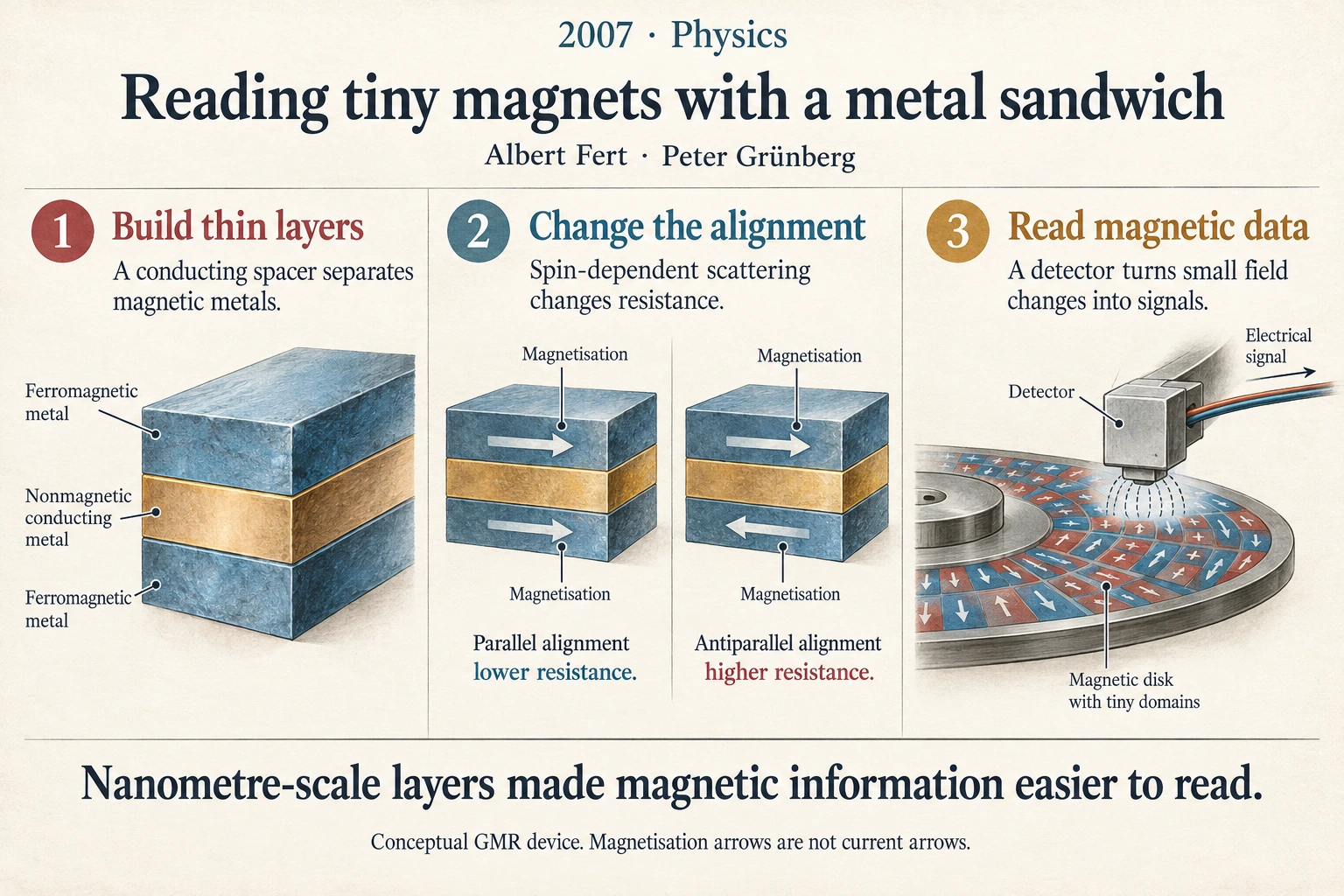
A magnetic hard disk stores information in tiny regions with different magnetic arrangements. Reading smaller regions calls for a detector that can sense small magnetic changes. Fert and Grünberg independently found that a stack of extremely thin magnetic and non-magnetic metal layers could change its electrical resistance far more strongly than familiar magnetoresistive materials.
The key is electron spin and how it affects scattering. In a simple layered example, parallel magnetisations let one spin channel pass relatively easily. With opposite magnetisations, each spin channel encounters stronger scattering in one of the magnetic layers, so the total resistance rises. A magnetic field can change the relative alignment. A circuit then detects a change in resistance, converting magnetic information into an electrical signal.
Why it matters
Commercial GMR reading heads appeared in 1997 after further materials and engineering advances, including work on scalable fabrication. They helped make densely packed magnetic data readable. The discovery also strengthened spintronics, which uses electron spin as well as charge. The historical achievement is a sensitive detector, not the invention of the whole computer or hard disk.