A life in context
The person behind the prize
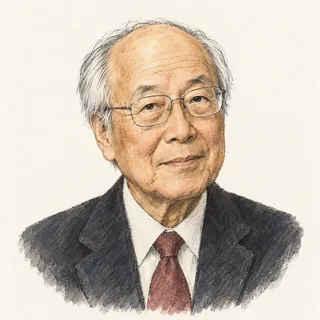
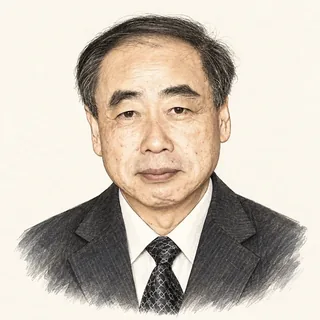
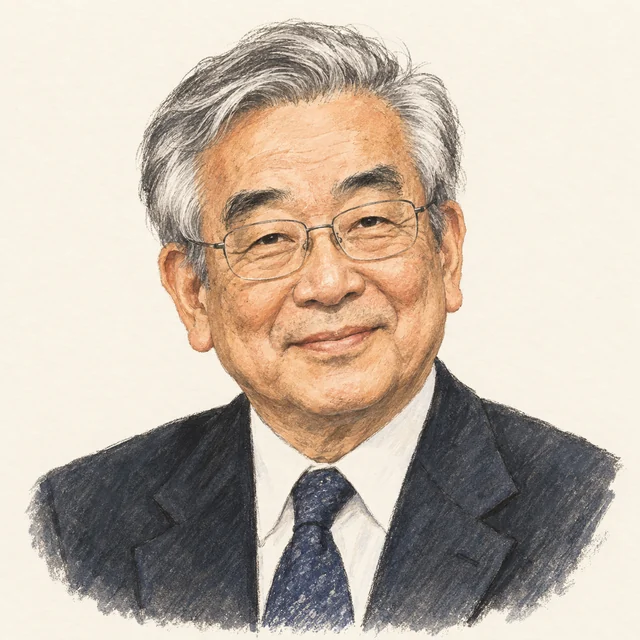
Maskawa grew up in Nagoya in a family that traded goods, including sugar. He chose theoretical physics, completing his doctorate at Nagoya University in 1967. At Kyoto University he collaborated with Makoto Kobayashi on weak interactions and the limits of symmetry. His later affiliations included Kyoto’s Yukawa Institute and Kyoto Sangyo University.
The contribution
Maskawa and Kobayashi analysed how CP violation could arise in a consistent theory of weak interactions. Their three-family quark framework introduced a physically meaningful complex phase in quark mixing, allowing some particle and antiparticle processes to differ. The work made a testable connection between a mathematical structure and particles still to be established experimentally; it was not the original experimental discovery of CP violation.
The idea in plain language
Nambu studied spontaneous symmetry breaking. A system’s equations can treat several possibilities equally, while its lowest-energy state selects one of them. Drawing on ideas from superconductivity, he brought this distinction into subatomic physics. The apparently less-symmetric state does not mean the original equations have been rewritten. His methods became fundamental to the description of particles and their interactions.
Read the full award story ↗