01 · The discovery
The idea, in everyday language
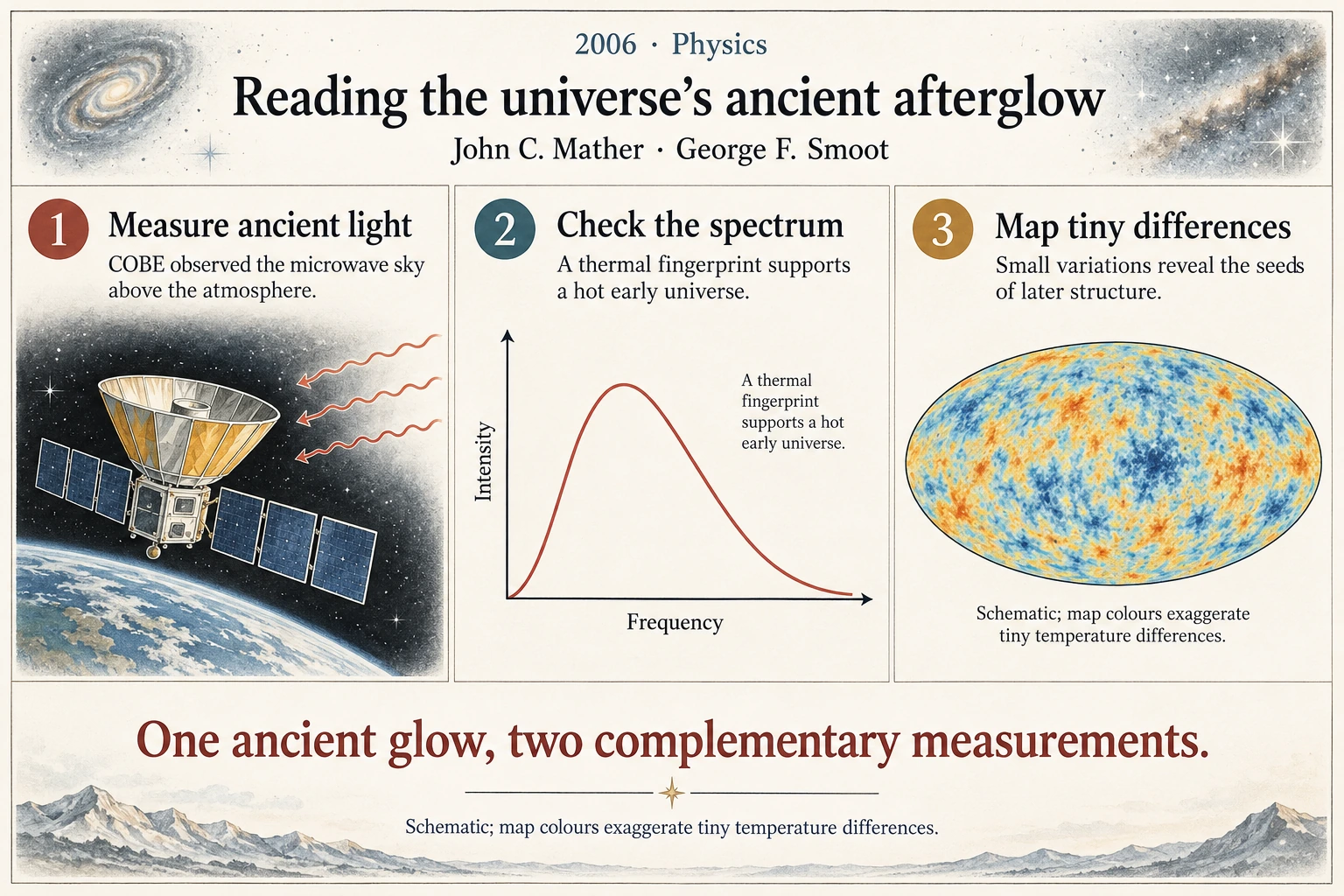
The sky contains a faint microwave glow left from an early hot stage of the universe. As space expanded, that radiation stretched and cooled. COBE measured it from above the atmosphere. Mather’s experiment found the precise pattern of intensity across frequencies expected from thermal radiation, a blackbody spectrum at about 2.7 kelvin today.
Smoot’s experiment asked a different question: is the glow exactly the same in every direction? In 1992 its team reported tiny intrinsic variations, roughly one part in a hundred thousand. These patterns carry information about early differences in density and gravity. They helped connect the nearly uniform early universe to the later growth of galaxies and large-scale structure.
Why it matters
The measurements turned a broad account of a hot early universe into a theory that could face precise observational tests. They established foundations for later microwave-background missions and for estimating cosmological properties from detailed sky measurements. Careful removal of foreground radiation and instrumental effects was essential.