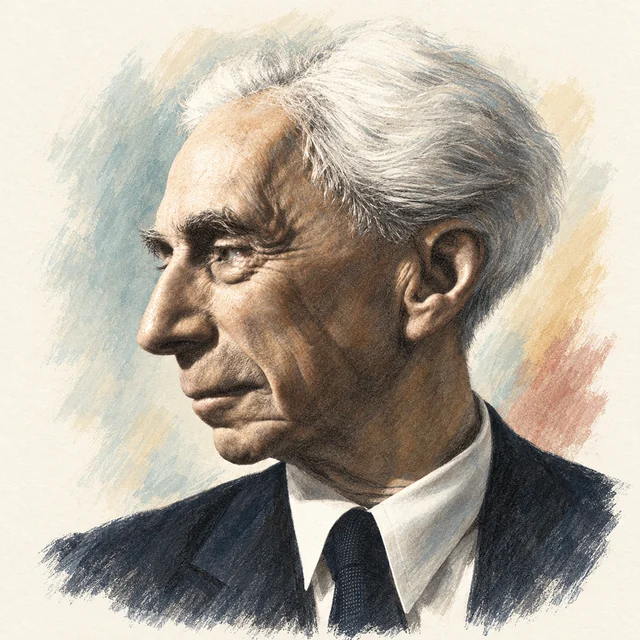
A life in context
The person behind the prize
Russell entered Trinity College Cambridge in 1890, studied mathematics and philosophy and became a Fellow in 1895. The Principles of Mathematics appeared in 1903; with Alfred North Whitehead he produced Principia Mathematica in 1910–1913. He also wrote for readers outside specialist logic, examining knowledge, education, power and the conditions of a free society. Opposition to wartime conscription cost him his Trinity lectureship in 1916, and imprisonment followed in 1918. He was re-elected a Trinity Fellow in 1944. Books such as History of Western Philosophy, Authority and the Individual and Unpopular Essays brought philosophical argument into wider public discussion. The 1950 Literature Prize recognised his varied writing in support of humanitarian ideals and freedom of thought, rather than one book alone or a mathematical theorem. His later nuclear-disarmament initiatives belong to subsequent history. Recognising his public reasoning does not require accepting every position in his long and changing political career.
The contribution
Russell’s varied writing defended humanitarian ideals and freedom of thought, bringing philosophical argument to a broad readership. He received the full Literature Prize.
The idea in plain language
How can difficult ideas become part of public reasoning? Russell addressed readers beyond the specialists who knew his work in mathematical logic. Essays and books on philosophy, science, education and society used clarity, argument and wit to challenge inherited assumptions and make intellectual questions widely accessible.
Read the full award story ↗

