A life in context
The person behind the prize
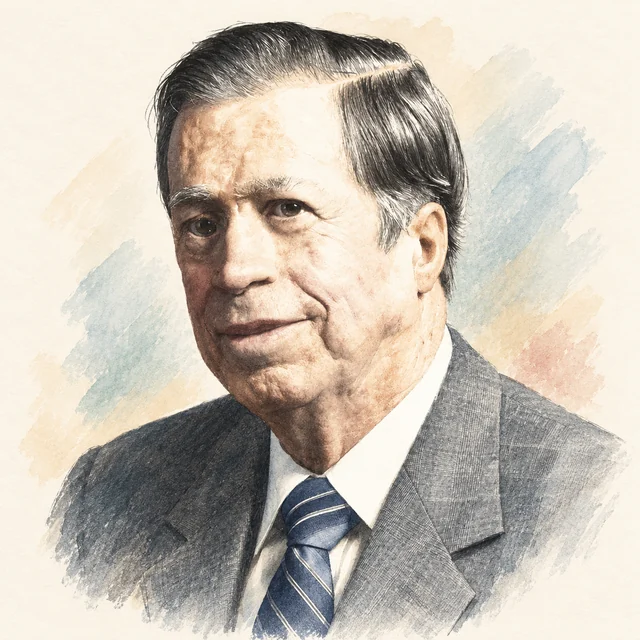
Merrifield grew up in California, attended Pasadena Junior College and studied chemistry at UCLA. Work at the Philip R. Park Research Foundation preceded graduate research with M. S. Dunn; he earned his doctorate in 1949. That June he married biologist Elizabeth “Libby” Furlong and moved to the Rockefeller Institute to work with D. W. Woolley. Studying peptide growth factors prompted his 1959 idea of anchoring a growing chain to an insoluble support. His 1963 paper introduced solid-phase peptide synthesis, and subsequent refinements enabled automation and more demanding syntheses. He became a Rockefeller professor in 1966 and John D. Rockefeller Jr. Professor in 1984. Libby later joined his laboratory.
The contribution
Merrifield developed chemical synthesis on a solid matrix: a growing peptide remains attached to insoluble resin while protected amino acids are added and soluble reagents washed away. Repeated coupling and deprotection can be organised systematically, followed by cleavage and appropriate purification. The method transformed access to peptides; it does not guarantee every long protein will be pure or fold correctly. He received the full Chemistry Prize.
The idea in plain language
Synthesising a peptide means joining amino acids in a chosen order. Traditional solution methods demanded repeated separation of the growing product from excess reagents. Merrifield anchored the first amino acid to insoluble resin, so the chain stayed in place while soluble material could be washed away.
Read the full award story ↗

