A life in context
The person behind the prize
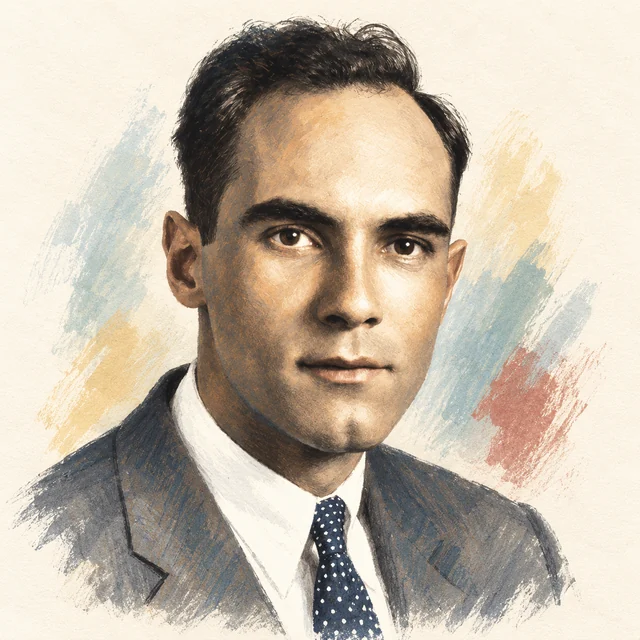
Anderson studied at Caltech, receiving his science degree in 1927 and doctorate in 1930. He stayed to investigate cosmic rays in Robert Millikan’s programme, designing a cloud chamber within a strong magnetic field. Photographs made particle paths visible, but a bend by itself could not distinguish a positive particle from a negative one travelling in the opposite direction. A lead plate provided the missing clue: a particle lost energy in crossing it and bent more sharply afterwards, revealing its direction. In 1932 Anderson obtained evidence for a positively charged particle with an electron-like mass, the positron. Research with Seth Neddermeyer subsequently investigated the production of electron–positron pairs. Anderson became assistant professor at Caltech in 1933 and received half the Physics Prize in 1936. His award recognised the positron, a different discovery from Hess’s cosmic radiation.
The contribution
Anderson received half the Physics Prize for discovering the positron. Cloud-chamber tracks, magnetic deflection and energy loss together supported the identification of a positive counterpart of the electron.
The idea in plain language
Why did an insulated electrical instrument slowly lose its charge even when carefully shielded? Radiation could ionise the surrounding air and make it conductive, but radioactivity in the ground did not explain all the observations. Hess took improved instruments into balloons in 1911–1912. Ionisation first fell, then rose markedly at greater heights. Combined with night and eclipse observations, this supported radiation arriving from outside Earth, rather than a simple explanation based on the ground or ordinary sunlight.
Read the full award story ↗