c.curionodeThe Nobel Archive

1936 · Physics

Radiation from space, a new kind of electron

Hess traced a penetrating radiation to beyond Earth. Anderson used particle tracks to discover the positively charged electron, the positron. They shared the prize for these distinct discoveries.

Cosmic raysPositronIonisationCloud chamber
1936Physics

Visual guide

The prize, pictured

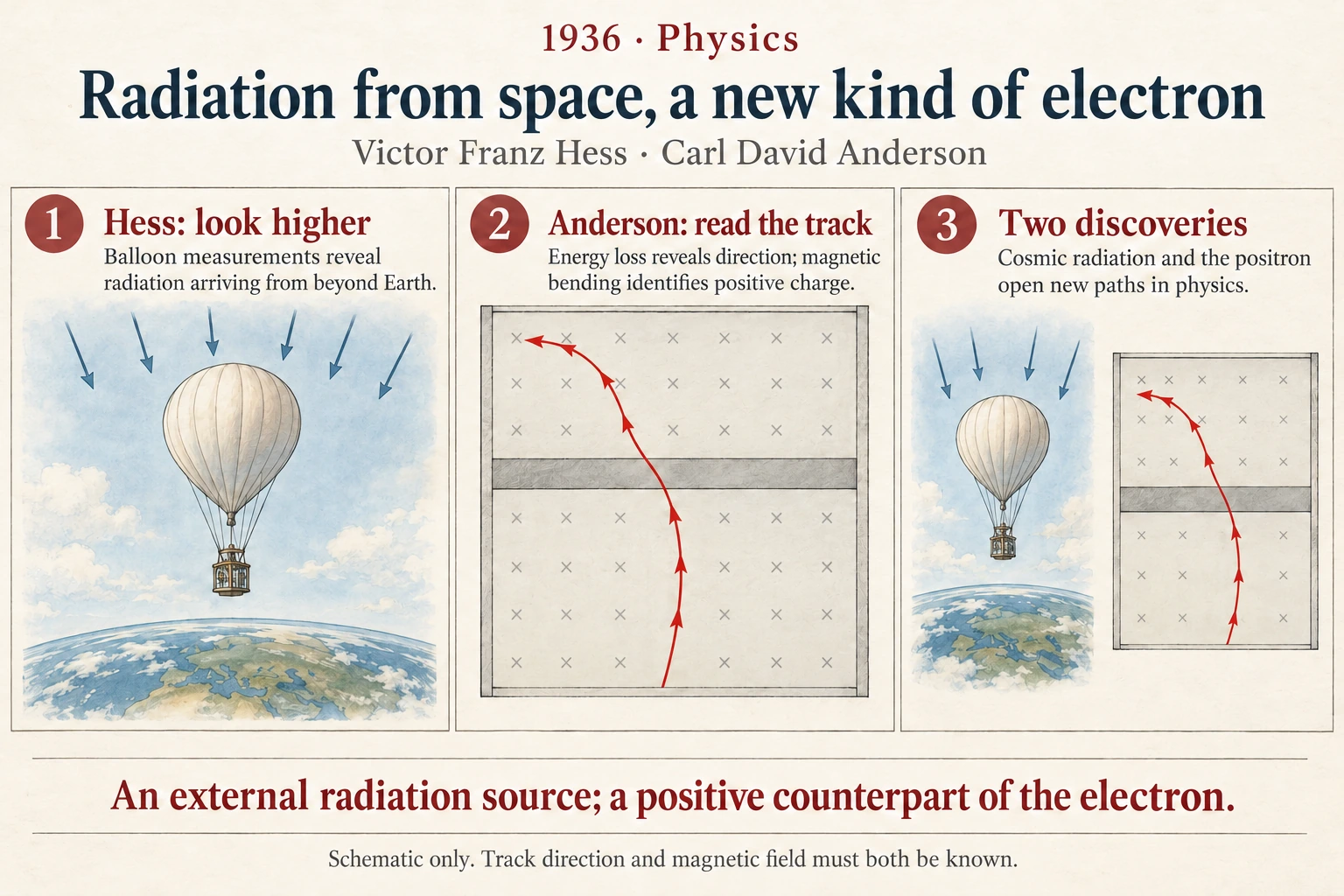
Infographic explaining Radiation from space, a new kind of electron
Original AI-generated infographic. A conceptual overview; the explanations and sources below provide context.
Read the poster text

An external radiation source; a positive counterpart of the electron.

  1. Hess: look higher

    Balloon measurements reveal radiation arriving from beyond Earth.

  2. Anderson: read the track

    Energy loss reveals direction; magnetic bending identifies positive charge.

  3. Two discoveries

    Cosmic radiation and the positron open new paths in physics.

Schematic only. Track direction and magnetic field must both be known.

01 · The discovery

The idea, in everyday language

Why did an insulated electrical instrument slowly lose its charge even when carefully shielded? Radiation could ionise the surrounding air and make it conductive, but radioactivity in the ground did not explain all the observations. Hess took improved instruments into balloons in 1911–1912. Ionisation first fell, then rose markedly at greater heights. Combined with night and eclipse observations, this supported radiation arriving from outside Earth, rather than a simple explanation based on the ground or ordinary sunlight.

Cosmic-ray research also opened a way to investigate particles. At Caltech, Anderson photographed cloud-chamber tracks in a magnetic field. Curvature alone left an ambiguity between charge and direction. A lead plate helped resolve it: energy loss made a particle curve more tightly after crossing, indicating which way it travelled. With the magnetic field known, the bending then established positive charge. The track’s properties were consistent with an electron-like mass rather than a proton. The 1932 evidence identified the positron, now understood as the electron’s antiparticle.

Why it matters

The work connected atmospheric measurements with particle physics. Cosmic rays supplied naturally occurring high-energy particles, while the positron provided experimental evidence for a positive counterpart of the electron. The award did not credit Hess and Anderson with the same experiment or with every later discovery involving antimatter.
02 · The people

Who brought the idea to life?

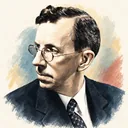
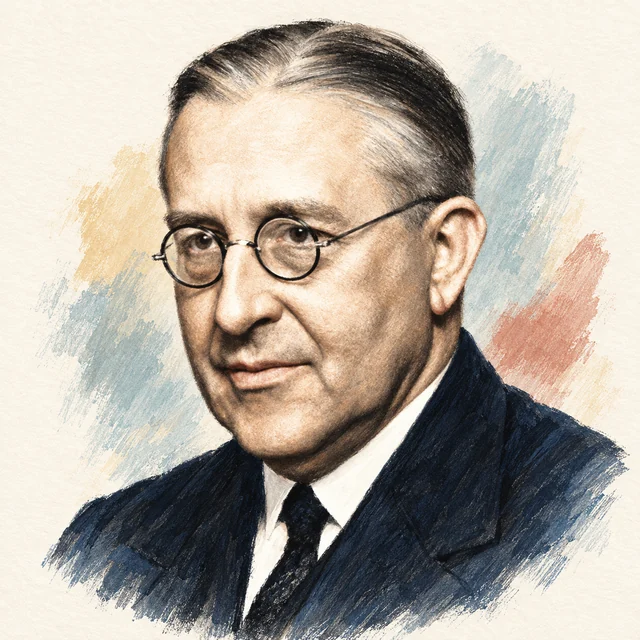
Illustrated portrait of Victor Franz Hess

Victor Franz Hess

Prize share · 1/2

Hess received half the Physics Prize for discovering cosmic radiation. Carefully controlled balloon measurements showed that the penetrating radiation could not be explained by radioactive material in the ground alone.

Read the biography ↗
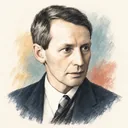
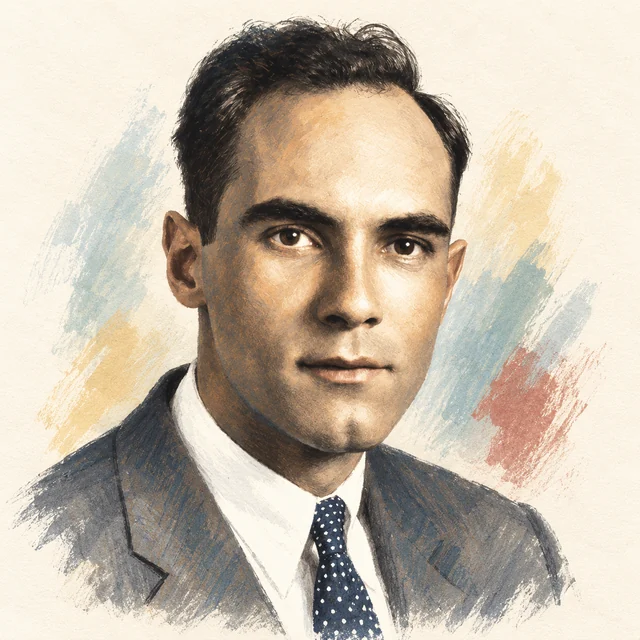
Illustrated portrait of Carl David Anderson

Carl David Anderson

Prize share · 1/2

Anderson received half the Physics Prize for discovering the positron. Cloud-chamber tracks, magnetic deflection and energy loss together supported the identification of a positive counterpart of the electron.

Read the biography ↗

03 · Years in the making

The path here

  1. 1911–1912

    Hess makes balloon measurements of atmospheric ionisation.

  2. 1912

    The rise at high altitude supports penetrating radiation from outside Earth.

  3. 1931

    Hess begins his Innsbruck period and mountain-station observations.

  4. 1932

    Anderson obtains evidence for the positive electron.

  5. 1936

    Hess and Anderson receive equal halves of the Physics Prize for different discoveries.

04 · Read further

From the original sources

Original explanations by Curionode, based on the official records below. Biographical details and affiliations refer to the award year.

  1. Official award summary nobelprize.org
  2. Award ceremony speech nobelprize.org
  3. Graz University: Victor Hess gams.uni-graz.at
  4. Caltech Archives: the positron track digital.archives.caltech.edu
  5. Official biography: Victor Franz Hess nobelprize.org
  6. Official biography: Carl David Anderson nobelprize.org