01 · The discovery
The idea, in everyday language
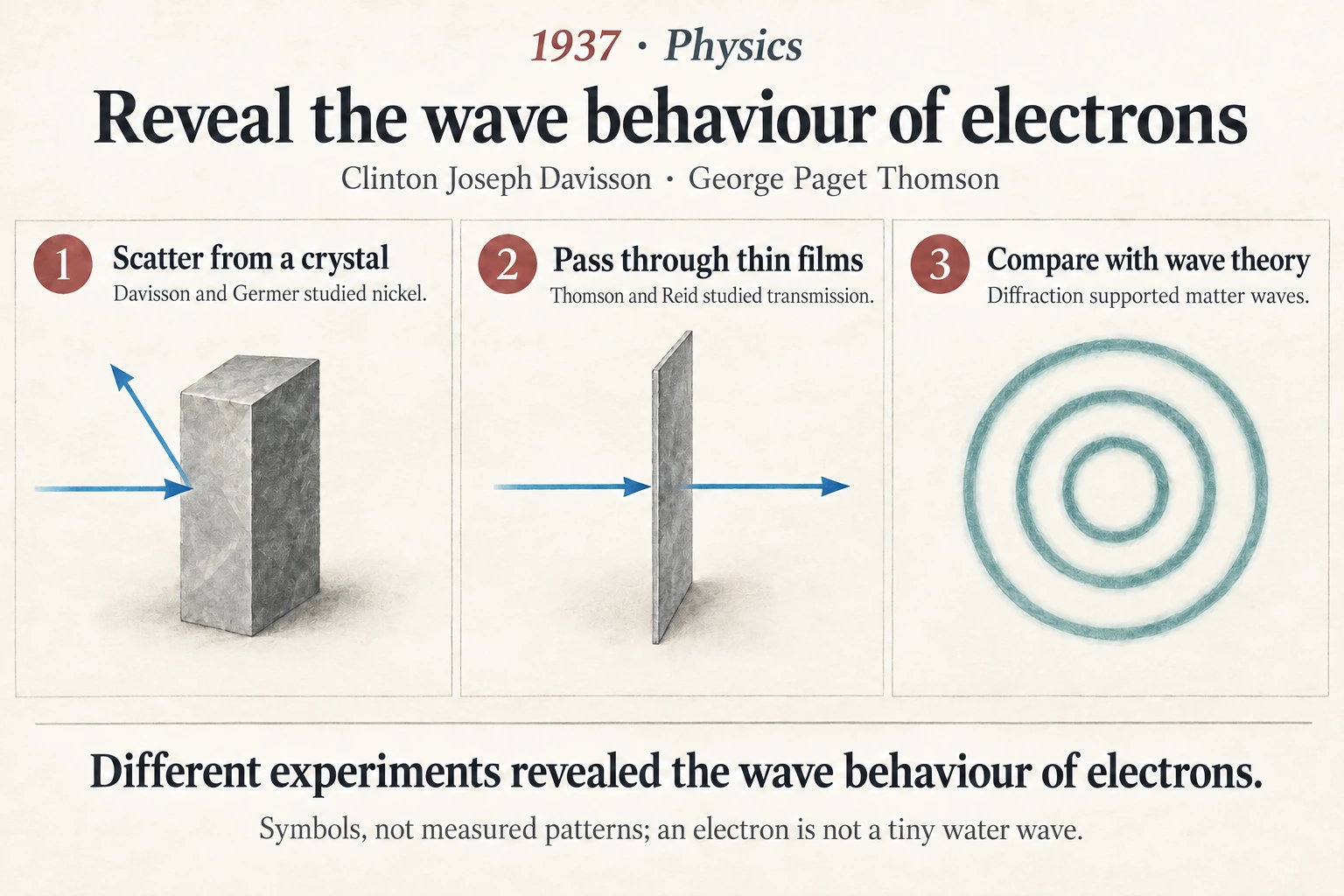
An electron leaves localised traces, yet its behaviour cannot always be explained as a tiny classical projectile. De Broglie proposed a relation between a particle’s momentum and an associated wavelength. Crystals, with their regular atomic arrangement, offered a test: a beam with wave properties could produce preferred directions and interference rather than a featureless spread.
Davisson and Germer studied electrons scattered from a nickel crystal at Bell Laboratories. Thomson and Reid sent electrons through very thin films at Aberdeen; rings appeared on a photographic plate. Follow-up experiments with metal films related the patterns to crystal structure and electron momentum. These were independent methods, not two accounts of the same nickel-transmission experiment. Both produced evidence consistent with matter waves.
Why it matters
Electron diffraction strengthened the experimental basis of quantum physics. Once wavelength and momentum could be related, diffraction could also help investigate atomic arrangements. Electron and X-ray methods have different interactions with matter and different useful ranges; neither is a universal replacement for the other.