01 · The discovery
The idea, in everyday language
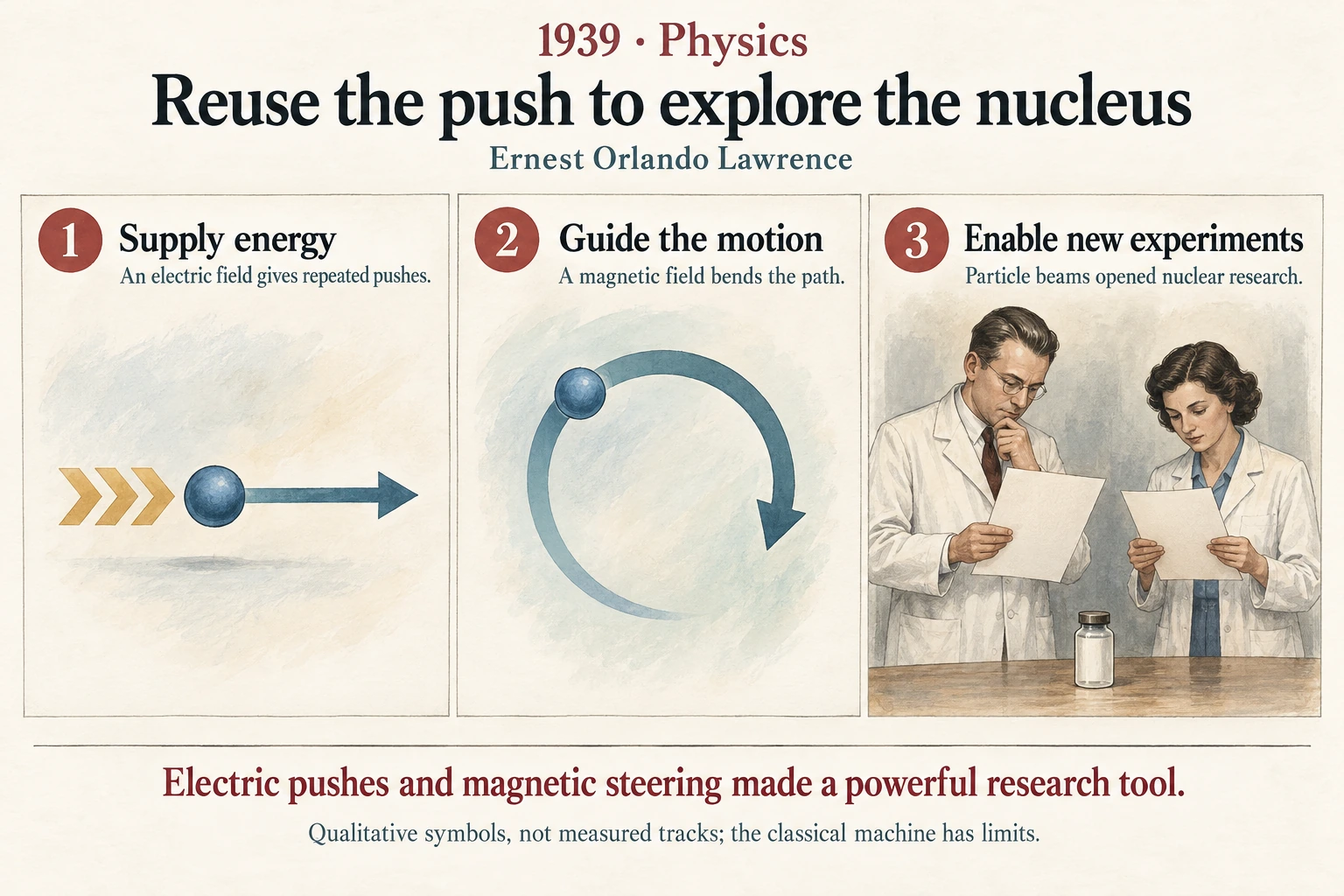
Nuclear experiments needed energetic particles that could be directed at matter. One approach used a very large voltage to supply energy in a single passage. Lawrence’s idea was to make the same accelerating region useful repeatedly: a magnetic field returned charged particles to it, while an alternating electric field supplied another push at the appropriate part of their journey.
The two fields have different jobs. The electric field adds kinetic energy; the magnetic field bends the moving charge’s path. In the classical cyclotron, increasing energy means wider orbits while the circulation can stay in step with a fixed-frequency electric field over a useful range. The device became an effective source of particle beams for nuclear reactions and artificial radioactive isotopes. Lawrence’s organisation and the work of Livingston and many other collaborators turned an idea into a research instrument.
Why it matters
The instrument expanded what could be tested in nuclear physics and made radioactive isotopes more accessible to research in chemistry, biology and medicine. This was a platform for many investigators, not a claim that Lawrence discovered every isotope or invented artificial radioactivity. Later accelerator designs extended the energies and capabilities beyond the classical cyclotron.