A life in context
The person behind the prize
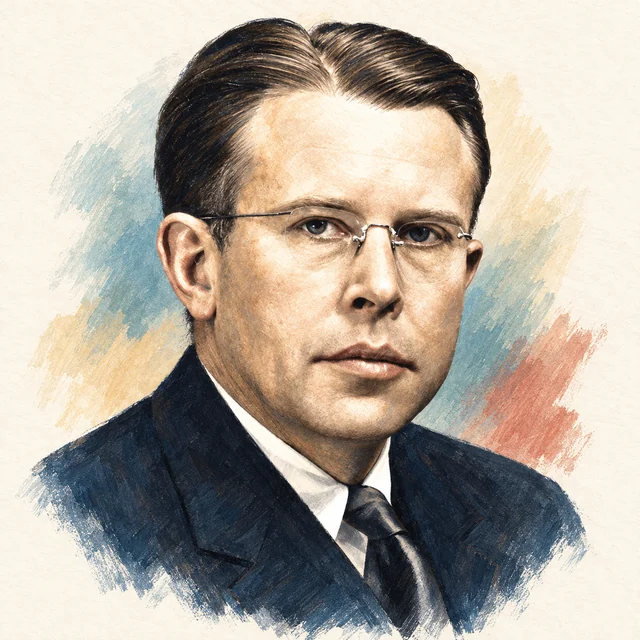
Lawrence studied at South Dakota and Minnesota before receiving his physics doctorate at Yale in 1925. He moved to the University of California, Berkeley, in 1928. His earlier work included photoelectric and ionisation phenomena, but the problem of giving charged particles enough energy for nuclear experiments became central. Inspired by Rolf Wideröe’s linear-accelerator idea, he conceived a way to reuse an accelerating gap by bending the particles back around it. Prototype work with Niels Edlefsen in 1930 was followed by a successful machine built with M. Stanley Livingston in January 1931. Lawrence organised an expanding collaboration of physicists, engineers and students, and became director of the Radiation Laboratory in 1936. The cyclotron made new nuclear experiments and the production of radioactive isotopes possible on a much larger scale. His whole 1939 Physics Prize recognised the instrument and results obtained with it. Wartime conditions led to the medal and diploma being presented in Berkeley on 29 February 1940. His later wartime atomic-bomb work was a subsequent part of his career, not the cited 1939 contribution.
The contribution
Lawrence received the whole Physics Prize for inventing and developing the cyclotron and for results obtained with it, especially artificial radioactive elements. Its development depended on a substantial team.
The idea in plain language
Nuclear experiments needed energetic particles that could be directed at matter. One approach used a very large voltage to supply energy in a single passage. Lawrence’s idea was to make the same accelerating region useful repeatedly: a magnetic field returned charged particles to it, while an alternating electric field supplied another push at the appropriate part of their journey.
Read the full award story ↗

