01 · The discovery
The idea, in everyday language
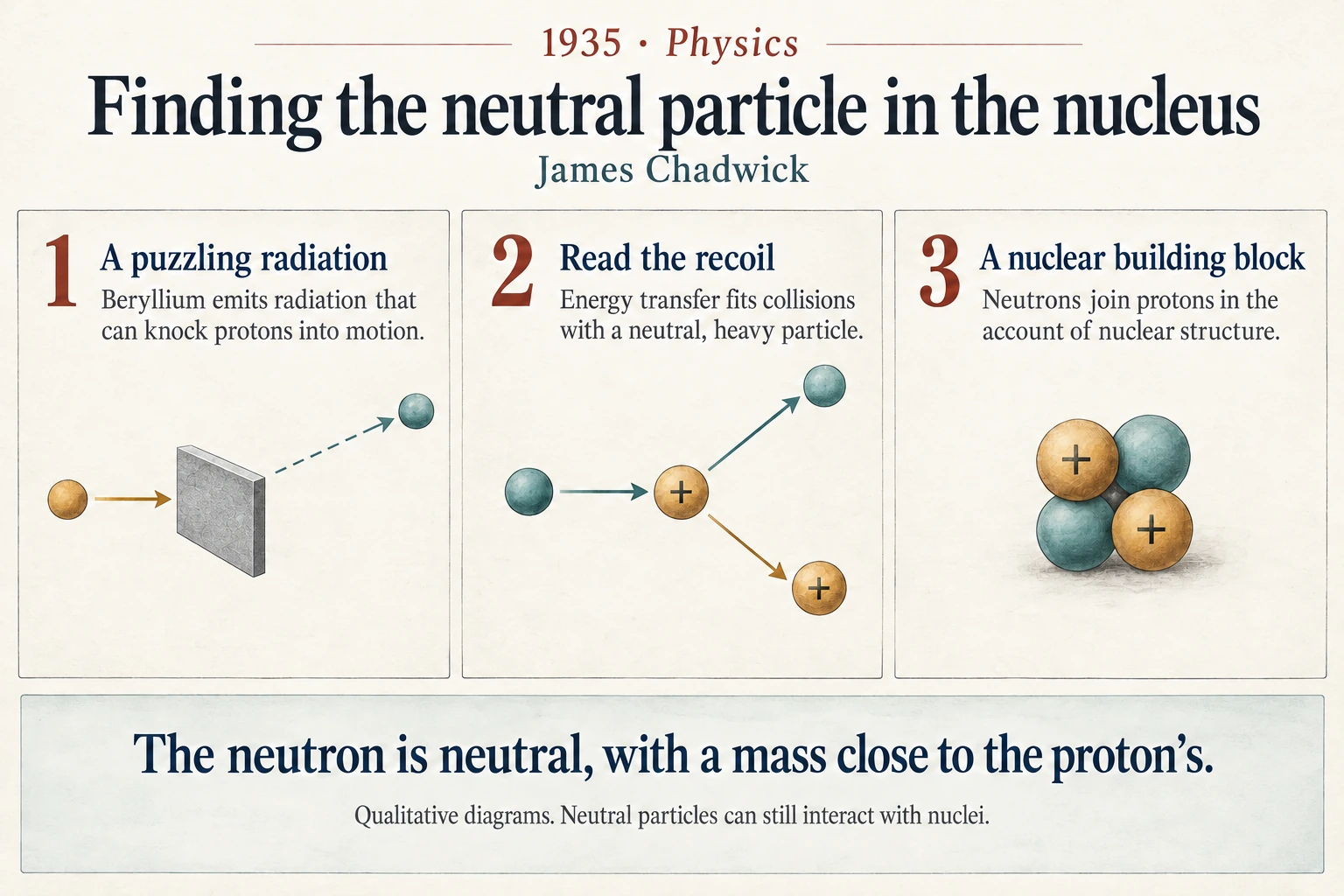
By 1930 Bothe and Becker had observed penetrating radiation when alpha particles struck beryllium. Irène and Frédéric Joliot-Curie then found that this radiation could eject fast protons from hydrogen-containing material. They interpreted it as very energetic gamma radiation. Chadwick tested the energy transferred in collisions with different nuclei. The gamma-ray interpretation required implausible energies and failed to account consistently for the observations.
A different model fitted the evidence: the radiation contained particles with no electric charge and a mass close to the proton’s. Such particles could transfer substantial energy when colliding with nuclei. Chadwick’s 1932 experiments and calculations established the neutron and helped determine its mass. This changed the account of nuclear structure: a nucleus could contain positive protons and neutral neutrons, while isotopes of the same element could differ in neutron number. It was an inference tested against recoil measurements, not a photograph of a neutron glowing inside an atom.
Why it matters
The neutron clarified nuclear structure and became a powerful probe of matter. Its absence of electric charge lets it approach nuclei without the electrostatic repulsion faced by a positive projectile. Later neutron research helped open other fields; the 1935 prize specifically recognised the discovery, not every subsequent use.