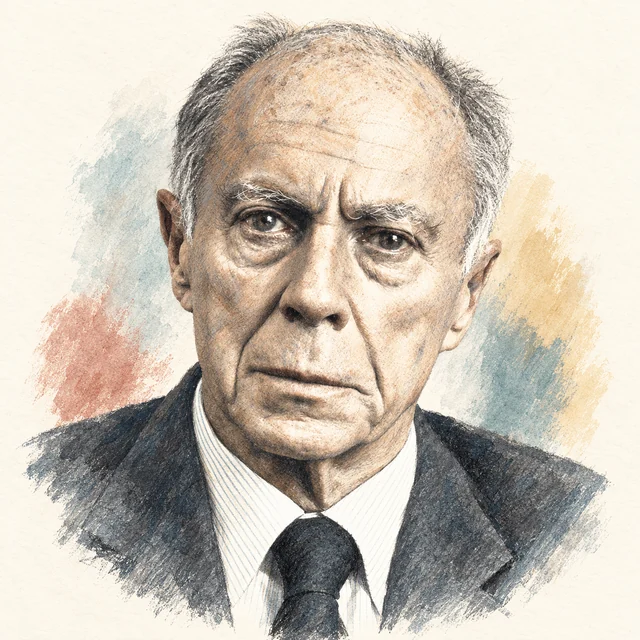
A life in context
The person behind the prize
Simon was born in Madagascar to French parents and grew up in Perpignan after his father died in the First World War. He studied painting with André Lhote and travelled in Europe, including Spain during the civil war. Mobilised in 1939, he was captured in 1940, escaped and joined the Resistance. His first novel, Le Tricheur, appeared in 1945. Le Vent and L’Herbe marked developments in his writing in the 1950s; La Route des Flandres brought international attention in 1960. Histoire won the Prix Médicis in 1967, and Les Géorgiques appeared in 1981. His writing repeatedly transformed family history, war and sensory experience through experiments in form.
The contribution
Simon’s prose combines poetic and painterly detail with attention to time, memory and the human condition. Fragmented scenes and shifting perspectives question an orderly, continuous account of experience. Often associated with the nouveau roman, his work has its own changing forms and recurring concerns. The Literature Prize recognised his body of writing, rather than a single book or a scientific theory of memory. He received the full prize.
The idea in plain language
An orderly story can make experience seem more continuous and certain than it feels. Simon’s novels return to war, family history, bodies, landscapes and remembered images through fragments and shifting perspectives. Dense sensory detail and long, moving sentences make the act of describing part of the work’s meaning.
Read the full award story ↗

