A life in context
The person behind the prize
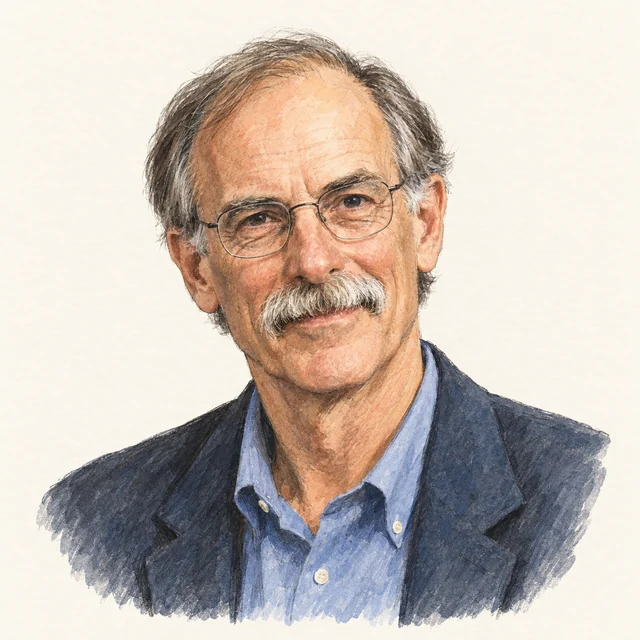
Wineland studied at the University of California, Berkeley, then earned his doctorate at Harvard in 1970 under Norman Ramsey. He worked with Hans Dehmelt at the University of Washington before joining the US standards laboratory in Boulder in 1975, later known as NIST. His experiments combined precision measurement with control of individual ions, electrically charged atoms held in place by electromagnetic fields.
The contribution
Wineland and collaborators developed methods to cool trapped ions with lasers and control their internal and motional quantum states. Carefully timed light pulses could prepare superpositions and perform quantum logic operations. The same command of isolated atoms supported highly precise optical clocks, linking fundamental experiments with the practical measurement of time.
The idea in plain language
Quantum theory describes states that can interfere and become entangled, but delicate states are easily disrupted by their surroundings. To study them, researchers need more than a sensitive detector: they must isolate a system, prepare it and choose how to question it. Wineland’s team held charged atoms in electromagnetic traps. Laser light cooled their motion and controlled their internal states, allowing experiments that treated a single ion as a carefully managed quantum system.
Read the full award story ↗