A life in context
The person behind the prize
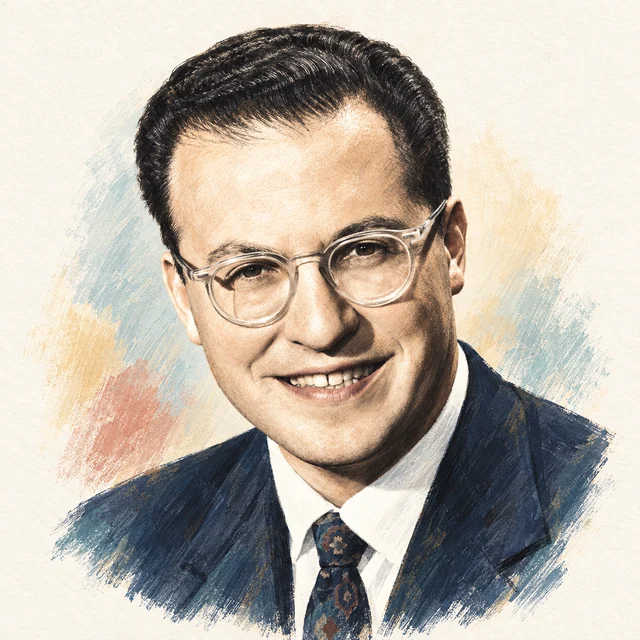
Glaser studied physics and mathematics at the Case Institute of Technology, graduating in 1946. At Caltech he investigated cosmic-ray particles: his doctoral work was completed in 1949, with the degree officially awarded in 1950. He began teaching and research at Michigan in 1949, becoming professor in 1957, and moved to Berkeley in 1959. Seeking better tools for high-energy particle research, he examined cloud chambers and other detectors before developing the bubble chamber in 1952. Ionising particles passing through a superheated liquid could leave trails of bubbles that could be photographed. Further engineering and experiments involved students and colleagues at Michigan and Berkeley. The 1960 prize recognised the invention, rather than every subsequent detector design. His move into molecular biology in 1962, biotechnology enterprises and later vision research belong to subsequent history.
The contribution
Glaser invented the bubble chamber, turning charged-particle passages through a suitable liquid into photographable bubble tracks. He received the full Physics Prize.
The idea in plain language
High-energy particles pass too quickly and are too small to inspect directly. Cloud chambers had made tracks visible in a gas, but researchers wanted a denser medium for studying energetic particles and their interactions.
Read the full award story ↗

