01 · The discovery
The idea, in everyday language
High-energy particles pass too quickly and are too small to inspect directly. Cloud chambers had made tracks visible in a gas, but researchers wanted a denser medium for studying energetic particles and their interactions.
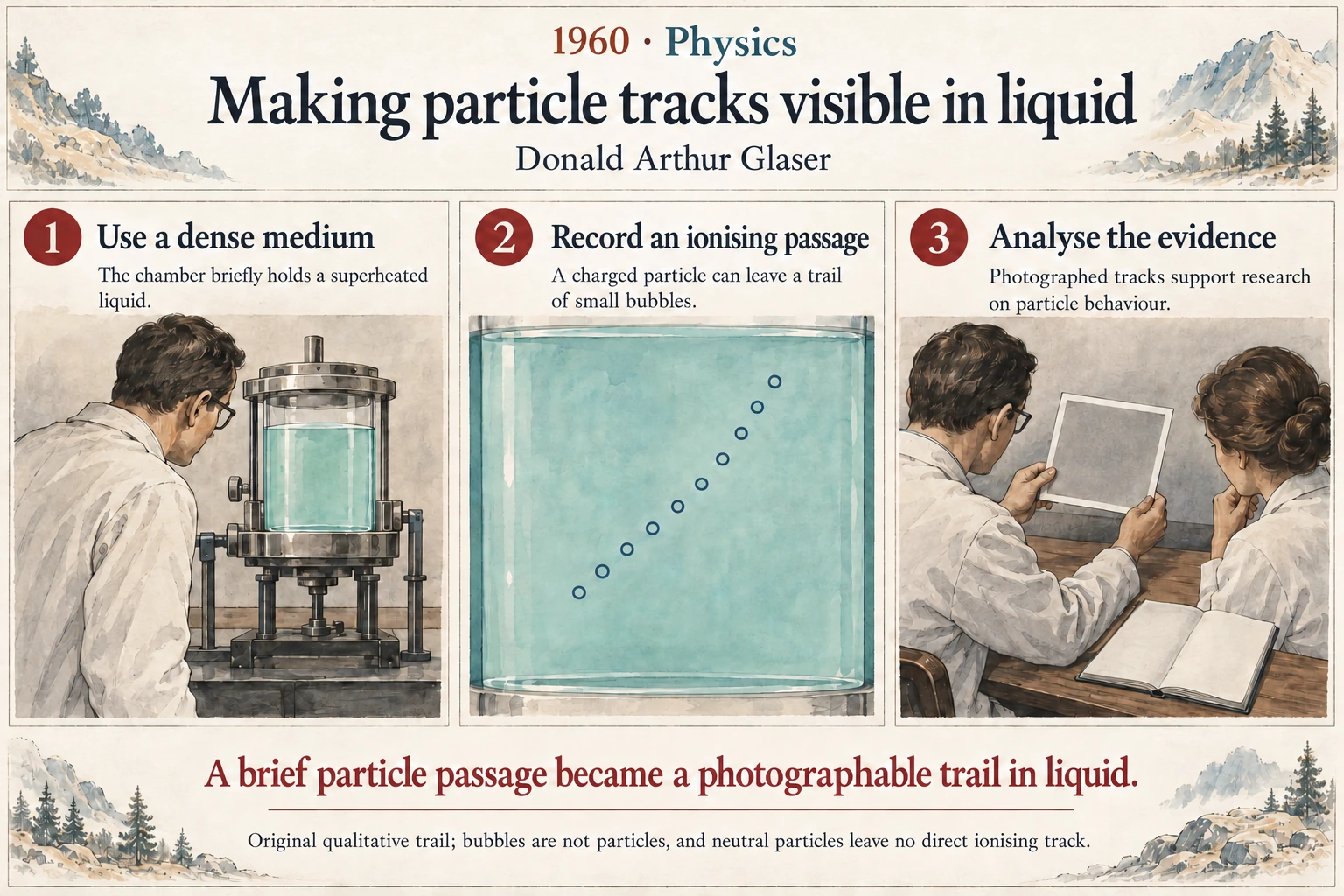
Glaser developed a chamber containing a liquid that could briefly be maintained in a superheated state. Ionisation along a charged particle’s path could initiate small bubbles. Rapid photography recorded the resulting trail before it dispersed. The first radiation-sensitive chamber followed in 1952, with further development by Glaser and other researchers.
Why it matters
A dense liquid allowed interactions to be studied in a compact instrument. Tracks, their curvature in a magnetic field and other evidence helped researchers infer particle behaviour. Glaser’s invention became a major tool in high-energy physics; practical chambers and analysis methods also depended on wider teams.