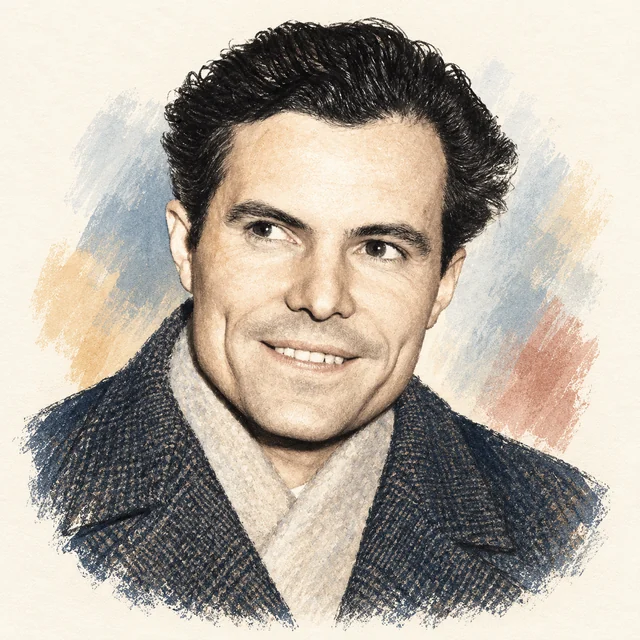
A life in context
The person behind the prize
Mössbauer began physics studies at Munich’s Technische Hochschule in 1949. After diploma research, he worked at the Heidelberg Max Planck institute during 1955–1957 on gamma-ray absorption, completing his doctorate under Maier-Leibnitz in January 1958. Unexpected results led him to investigate recoilless nuclear resonance absorption; direct experimental evidence and publication followed in 1958. The effect enabled very sharp resonance measurements and studies of nuclear levels in solids. He worked in Munich in 1959 and joined Caltech in 1960. The Nobel facts record both Munich and Caltech affiliations for 1961. His biography’s 1961 professorship date conflicts with his later 2005 correction to early 1962, so the appointment is not used as a dated milestone here. Later work in Munich, Grenoble and neutrino physics was subsequent history.
The contribution
Mössbauer discovered recoilless nuclear resonance absorption of gamma radiation, enabling precise measurements. He received one half of the Physics Prize.
The idea in plain language
Nuclei and their proton and neutron constituents are too small for ordinary inspection. Researchers needed ways to infer their internal distributions and to measure tiny changes in nuclear energy levels.
Read the full award story ↗