A life in context
The person behind the prize
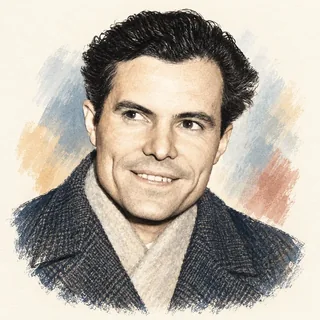
Hofstadter graduated from the City College of New York in 1935 and received his Princeton doctorate in 1938, studying infrared spectra. Work on crystals, detectors and wartime projects preceded his return to Princeton after the war. He developed scintillation detection using thallium-activated sodium iodide; work with McIntyre also established useful energy measurements. Moving to Stanford in 1950, he built apparatus for high-energy electron scattering using its linear accelerator. From 1953 this became his principal research, with students and colleagues investigating nuclear charge distributions and the charge and magnetic structure of protons and neutrons. Important nucleon results followed during 1954–1957, with increasingly precise form-factor studies. Stanford was his 1961 affiliation. His half of the prize recognised scattering and structure, separately from Mössbauer’s resonance work.
The contribution
Hofstadter developed electron-scattering measurements that revealed nuclear and nucleon structure. He received one half of the Physics Prize.
The idea in plain language
Nuclei and their proton and neutron constituents are too small for ordinary inspection. Researchers needed ways to infer their internal distributions and to measure tiny changes in nuclear energy levels.
Read the full award story ↗