01 · The discovery
The idea, in everyday language
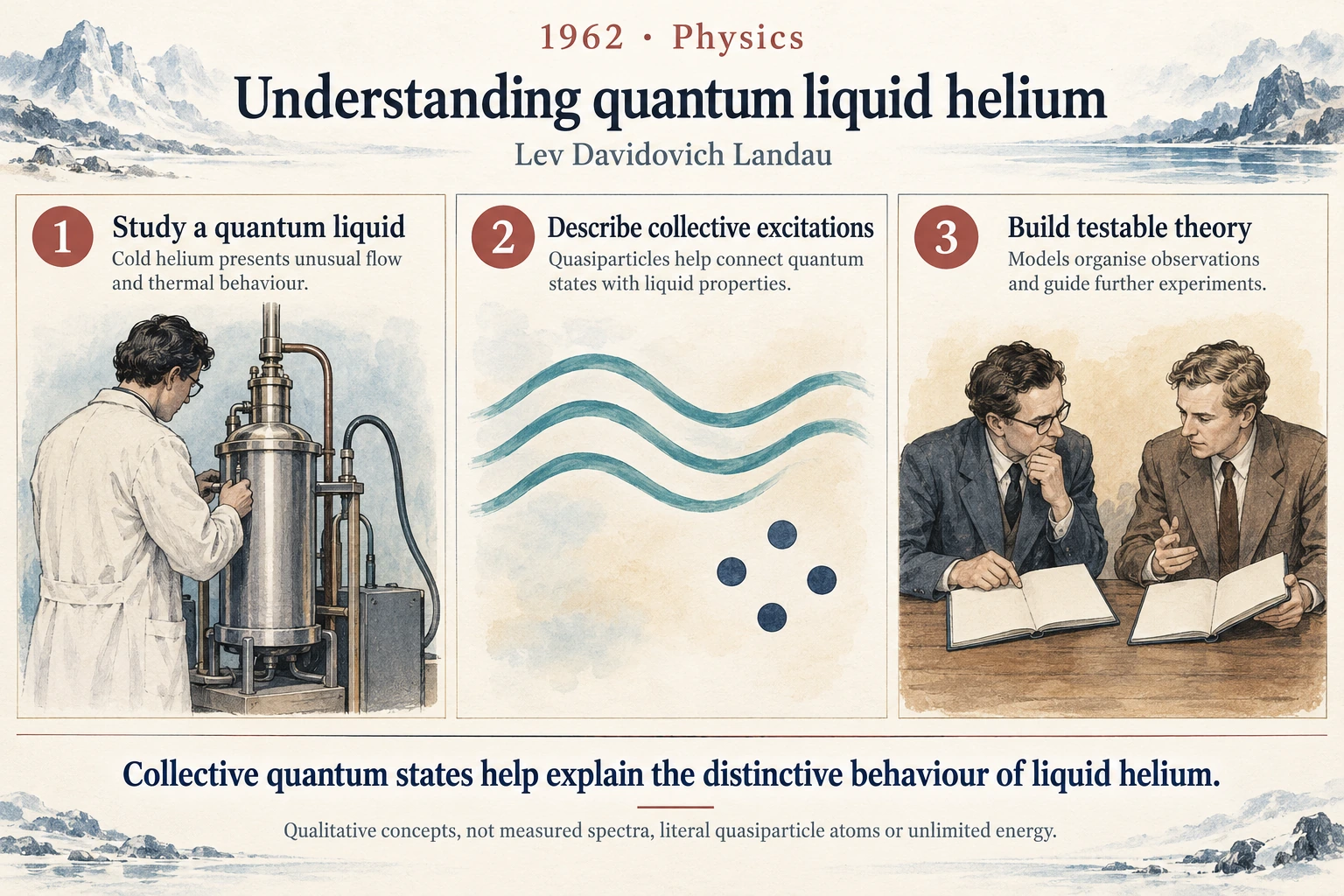
Liquid helium behaves in ways ordinary fluid models cannot explain. In helium-4 at sufficiently low temperatures, superfluid flow becomes possible. Experiments by Kapitsa and others posed questions about motion, heat and the liquid’s excitations.
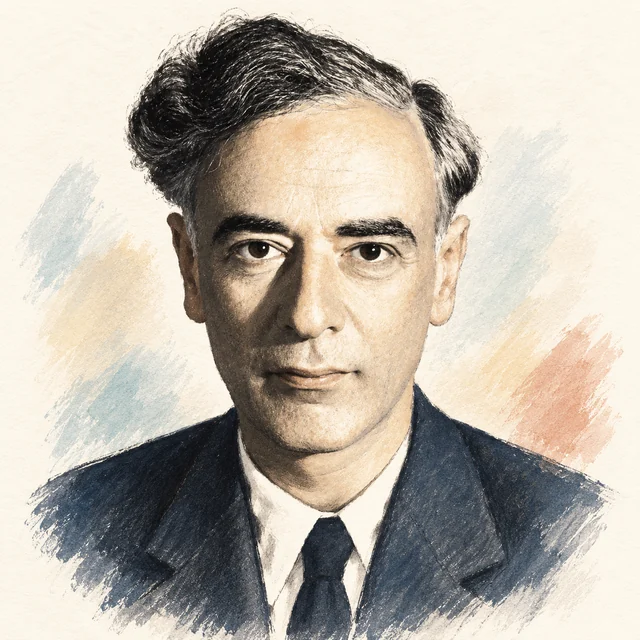
Landau treated the quantum states of the liquid as a whole. Its elementary excitations could be described as quasiparticles, including phonons and rotons, rather than independent classical atoms. His 1941 and 1947 work linked excitation properties with superfluid behaviour and second sound. Later Fermi-liquid theory addressed the very different helium-3 liquid.
Why it matters
The theories made important properties of quantum liquids understandable and testable. Neutron-scattering experiments subsequently examined the excitation spectrum. Landau received the full prize for pioneering condensed-matter theory, especially liquid helium; the recognition was broader than a single flow demonstration.