A life in context
The person behind the prize
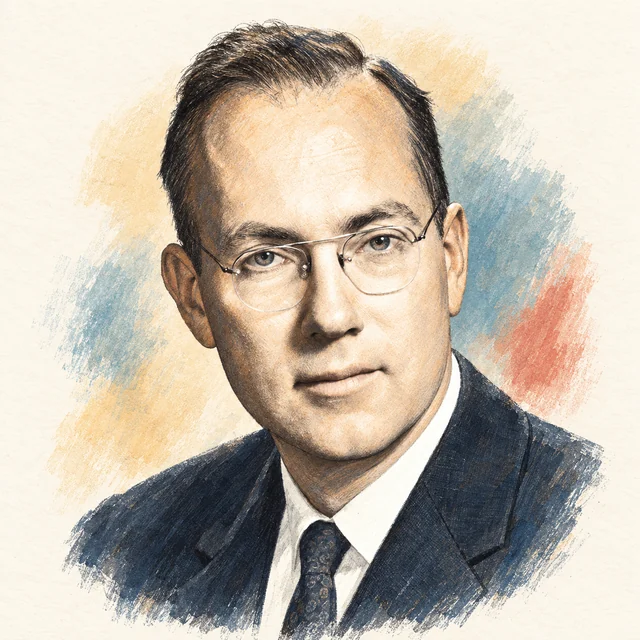
Townes graduated from Furman in 1935, completed a Duke master’s degree in 1936 and received his Caltech doctorate in 1939. He then joined Bell Laboratories, where wartime radar work led toward microwave spectroscopy. Columbia appointed him in 1948, and he became professor in 1950. His 1951 maser idea led to an ammonia device operating in 1954 with James Gordon and Herbert Zeiger. The collaboration showed how stimulated emission could amplify and generate microwave radiation. With Arthur Schawlow he analysed an optical version in 1958; Theodore Maiman demonstrated the first working laser in 1960. Townes became MIT provost and physics professor in 1961, his award affiliation. His later Berkeley career and astronomical discoveries belong to subsequent history. The prize recognised fundamental quantum electronics, alongside independent Lebedev research.
The contribution
Townes developed the maser and, with collaborators, the optical maser principle. He received one half of the Physics Prize.
The idea in plain language
Radiation can stimulate an excited atom or molecule to emit matching radiation. Under ordinary conditions absorption can dominate. Amplification requires suitable preparation, including more particles in the upper than the lower state of the relevant transition: a population inversion.
Read the full award story ↗