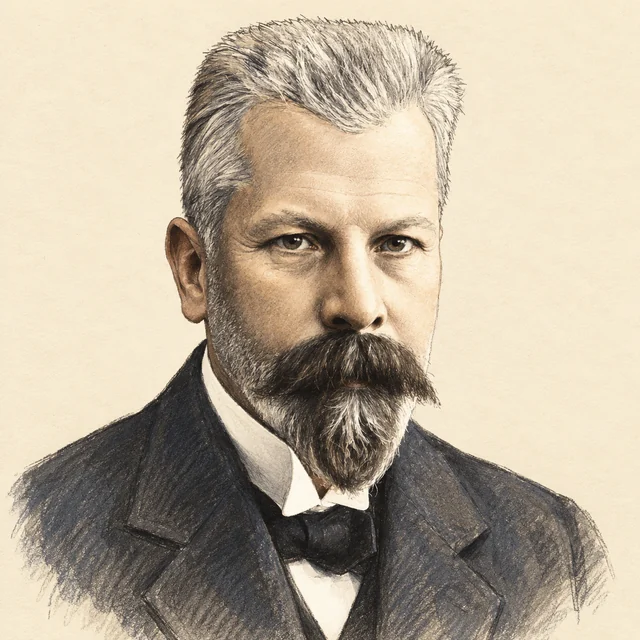
A life in context
The person behind the prize
Eduard Buchner was born in Munich. His father’s early death made money scarce, and work in a canning factory interrupted his chemical studies. He resumed systematic study in 1884 with Adolf von Baeyer and also investigated biological questions encouraged by his older brother Hans, a bacteriologist. He completed his doctorate in Munich in 1888, qualified to teach and took appointments in Kiel and Tübingen. The difficult question behind his best-known research was whether alcoholic fermentation required the organisation of a whole living yeast cell. During work in 1896 he obtained liquid from disrupted yeast cells. The liquid could still turn sugar into alcohol and carbon dioxide even when intact living yeast cells were absent. He published the discovery in 1897. The active material came from cells; the result did not create life from non-living matter. Buchner called the fermenting activity zymase, a historical name for what is now understood as a system of enzymes and associated components rather than one purified protein. In 1898 he became a professor at Berlin’s Agricultural College, his institution when awarded the full 1907 Chemistry Prize for biochemical research and cell-free fermentation. Work continued on the chemistry of fermentation, and the 1903 book Die Zymasegärung was coauthored with Hans Buchner and Martin Hahn. He later held chairs in Breslau and, from 1911, Würzburg. During the First World War he served in the German army and died in Romania in August 1917 after being wounded. His discovery helped make metabolism accessible to chemical analysis outside the intact cell, opening an experimental route that later researchers extended with enzyme separation, cofactors and reaction pathways.
The contribution
Buchner received the full Chemistry Prize for biochemical research and the discovery of cell-free fermentation: components extracted from yeast could ferment sugar without intact living yeast cells.
The idea in plain language
Yeast cells contain the machinery for converting sugar through a sequence of chemical reactions. Buchner obtained an active liquid from broken cells and showed that it produced alcohol and carbon dioxide without intact living yeast cells. The discovery, published in 1897, separated a biochemical activity from the complete organism that normally performs it.
Read the full award story ↗

