A life in context
The person behind the prize
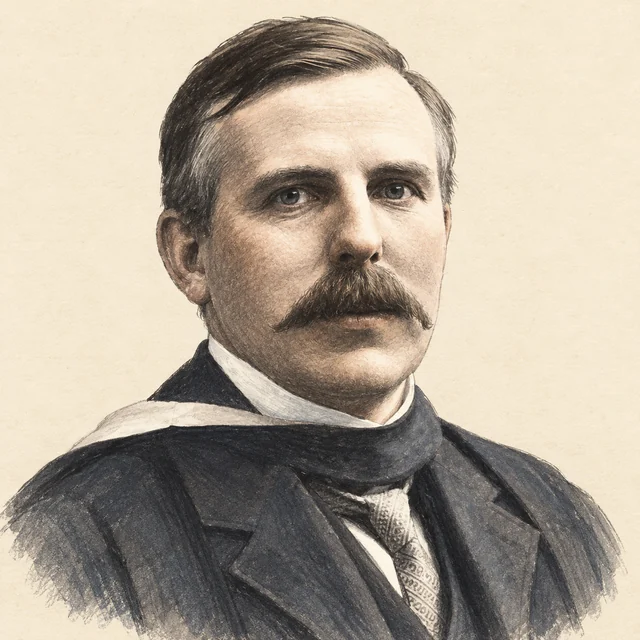
Ernest Rutherford grew up in New Zealand and studied at Canterbury College in Christchurch, earning degrees in mathematics and the physical sciences. He moved to Cambridge in 1895 to work with J. J. Thomson. Research on the electrical effects of radiation led him from radio-wave experiments towards the new problem of radioactivity. He distinguished alpha and beta radiation in the late 1890s and became a professor at McGill University in Montreal in 1898. There, work with R. B. Owens on thorium and with Frederick Soddy on radioactive transformations helped overturn the view that an element’s atoms must remain unchanged. Rutherford and Soddy proposed their disintegration theory in 1902: radioactive substances could produce new substances through changes within atoms, with characteristic rates of transformation. Careful separation and measurement mattered as much as the bold interpretation. Rutherford moved to Manchester in 1907 and received the full Chemistry Prize in 1908 for investigations of elemental disintegration and radioactive substances. That prize preceded the scattering experiments of Hans Geiger and Ernest Marsden and Rutherford’s nuclear model of 1911. These later developments should not replace the earlier discovery in the award story. His Manchester laboratory became a centre of collaborative research, and in 1919 he returned to Cambridge as Cavendish Professor. He was knighted in 1914 and became a baron in 1931, titles acquired after the Nobel award. He died in Cambridge in 1937. His work linked chemistry and physics by showing that some changes of matter involve the atom itself, beyond the rearrangement of atoms in an ordinary chemical reaction.
The contribution
Rutherford received the full Chemistry Prize for investigating the disintegration of elements and radioactive substances. With Soddy, he interpreted radioactive change as transformation within atoms, producing other substances at measurable rates.
The idea in plain language
Rutherford distinguished different types of radiation and investigated the changing activity of radioactive preparations. Work on thorium revealed a radioactive gaseous emanation and successive products. Separating substances and following their activity over time showed that the effect could not be understood simply as one ordinary chemical reaction.
Read the full award story ↗

