c.curionodeThe Nobel Archive

1908 · Chemistry

See elements change through radioactive decay

An element was once treated as an unchanging kind of matter. Rutherford’s investigations showed that radioactivity could accompany transformations within atoms, producing other substances at characteristic rates.

RadioactivityElemental transformationDecay rates
1908Chemistry

Visual guide

The prize, pictured

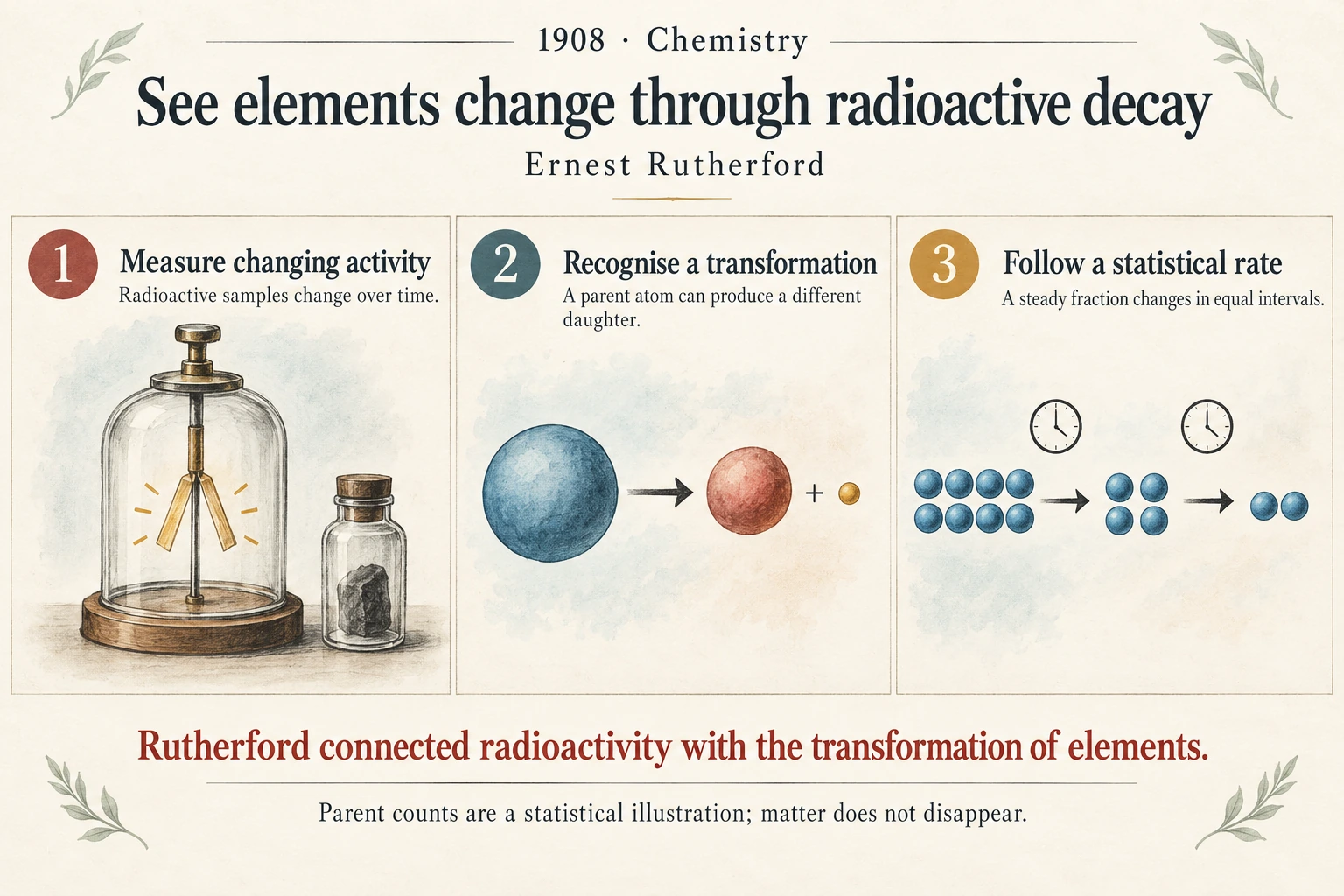
Infographic explaining See elements change through radioactive decay
Original AI-generated infographic. A conceptual overview; the explanations and sources below provide context.
Read the poster text

Rutherford connected radioactivity with the transformation of elements.

  1. Measure changing activity

    Radioactive samples change over time.

  2. Recognise a transformation

    A parent atom can produce a different daughter.

  3. Follow a statistical rate

    A steady fraction changes in equal intervals.

Parent counts are a statistical illustration; matter does not disappear.

01 · The discovery

The idea, in everyday language

Rutherford distinguished different types of radiation and investigated the changing activity of radioactive preparations. Work on thorium revealed a radioactive gaseous emanation and successive products. Separating substances and following their activity over time showed that the effect could not be understood simply as one ordinary chemical reaction.

With Frederick Soddy, Rutherford proposed the disintegration theory in 1902. Changes occurred within atoms themselves, producing new substances as radiation was emitted. Different products had characteristic rates of change. A sample’s activity could fall while a daughter product’s activity grew, making a sequence of transformations experimentally traceable. The 1908 award was in Chemistry, recognising elemental disintegration and radioactive substances.

Why it matters

The work changed the boundary of chemistry by showing that some elements are not permanently stable. Measured decay rates became tools for studying transformations and later for tracing time, while the experiments also helped create the field of nuclear physics.

02 · The people

Who brought the idea to life?

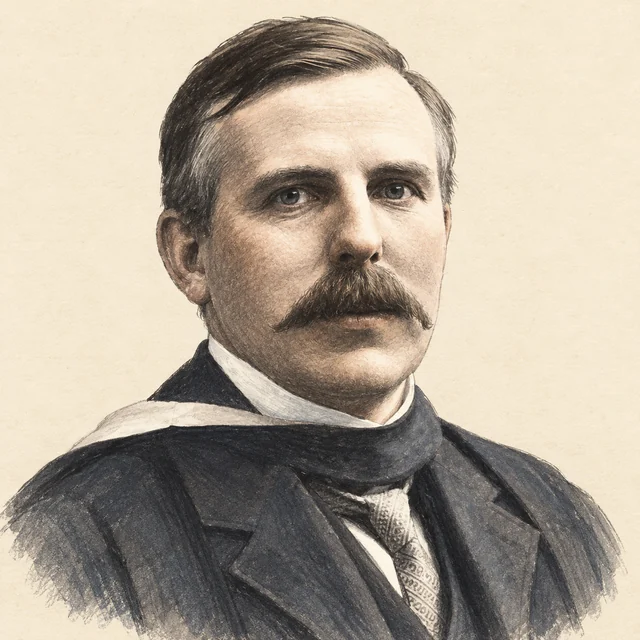
Illustrated portrait of Ernest Rutherford

Ernest Rutherford

Prize share · 1

Rutherford received the full Chemistry Prize for investigating the disintegration of elements and radioactive substances. With Soddy, he interpreted radioactive change as transformation within atoms, producing other substances at measurable rates.

Read the biography ↗

03 · Years in the making

The path here

  1. 1895

    Rutherford begins research at Cambridge with Thomson.

  2. 1898

    He moves to McGill University in Montreal.

  3. 1902

    Rutherford and Soddy propose the disintegration theory.

  4. 1907

    He moves to Manchester.

  5. 1908

    He receives the full Chemistry Prize.

  6. 1911

    His later nuclear model follows scattering research.

  7. 1919

    He becomes Cavendish Professor at Cambridge.

04 · Read further

From the original sources

Original explanations by Curionode, based on the official records below. Biographical details and affiliations refer to the award year.

  1. Official award summary nobelprize.org
  2. Award ceremony speech nobelprize.org
  3. University of Manchester: Rutherford and the nuclear model manchester.ac.uk
  4. University of Canterbury: Rutherford’s route to Cambridge canterbury.ac.nz

More in Chemistry

Browse this subject ↗