01 · The discovery
The idea, in everyday language
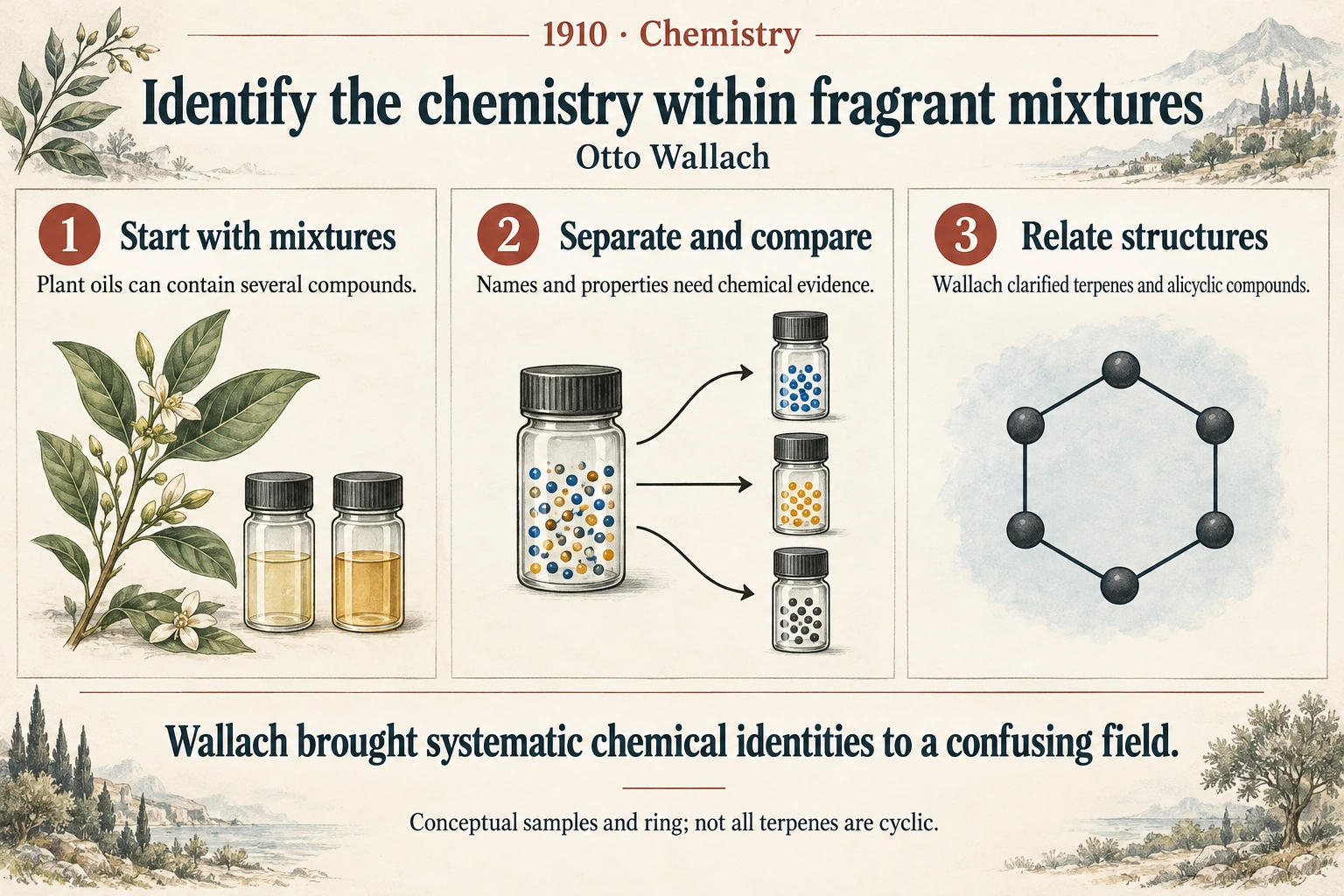
A plant’s fragrance is not a single chemical substance. Different oils may share a constituent, while compounds with similar properties can have different structures. Older names often followed the plant of origin, obscuring these relationships. Wallach used separation, comparison and chemical transformations to establish more reliable identities among terpenes and related compounds.
Analysis could itself change a compound, so a product formed during a test could not simply be assumed to have been present in the original oil. By relating derivatives, structures and transformations, Wallach and his students turned a confusing collection into a more coherent field. The full 1910 Chemistry Prize recognised his pioneering work on alicyclic compounds, whose carbon rings are non-aromatic. That class is broader than one essential oil, and not every terpene has a ring.
Why it matters
The research strengthened organic chemistry and helped industries working with fragrances, flavourings and related materials. Systematic identification made it easier to compare results from different plants and laboratories and to investigate how structures are related.