c.curionodeThe Nobel Archive

1911 · Chemistry

Find new elements through unusually active minerals

Some minerals were more radioactive than their known uranium content could explain. Curie combined measurements of that activity with chemical separation to identify polonium and radium and investigate radium’s properties.

RadioactivityPoloniumRadium
1911Chemistry

Visual guide

The prize, pictured

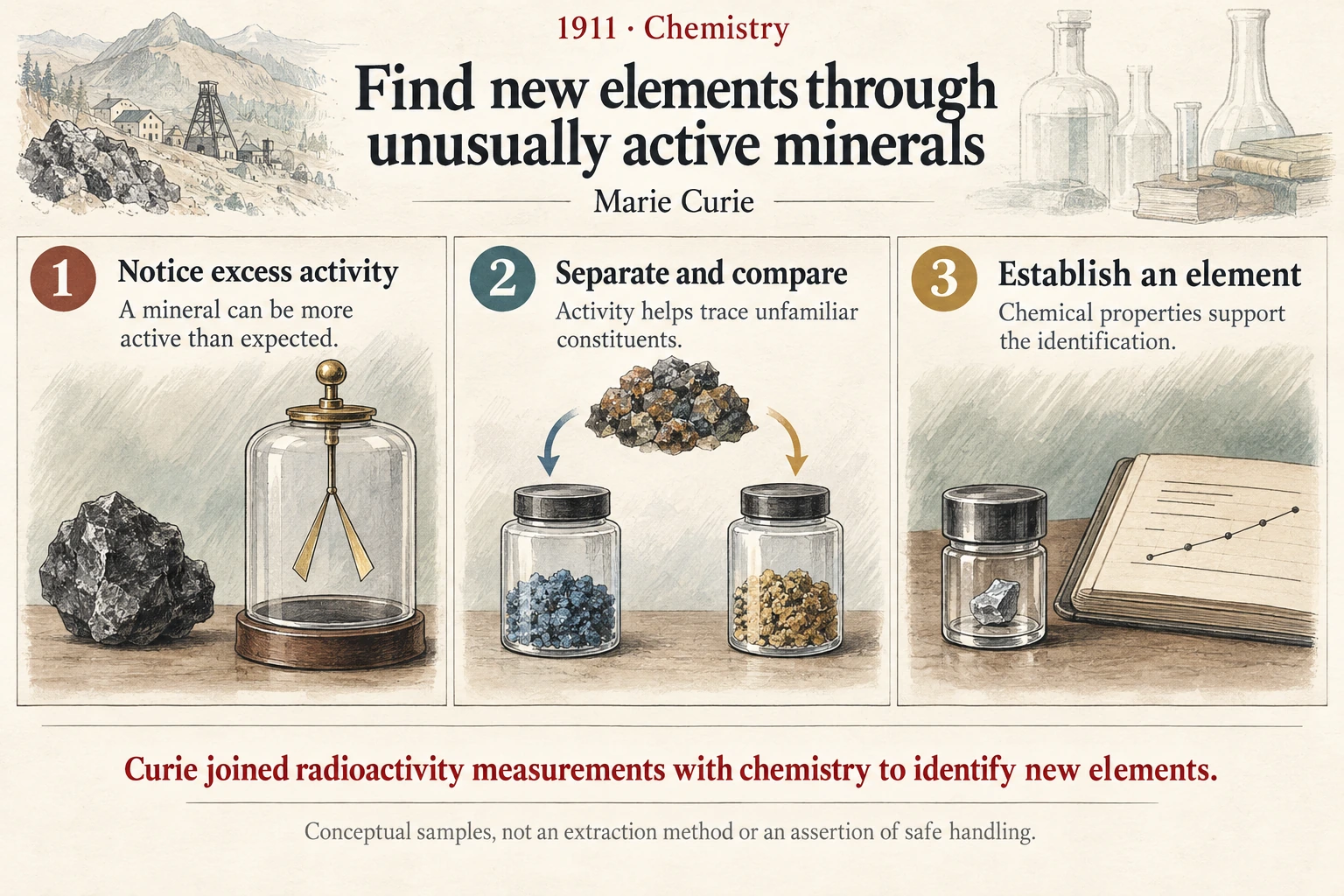
Infographic explaining Find new elements through unusually active minerals
Original AI-generated infographic. A conceptual overview; the explanations and sources below provide context.
Read the poster text

Curie joined radioactivity measurements with chemistry to identify new elements.

  1. Notice excess activity

    A mineral can be more active than expected.

  2. Separate and compare

    Activity helps trace unfamiliar constituents.

  3. Establish an element

    Chemical properties support the identification.

Conceptual samples, not an extraction method or an assertion of safe handling.

01 · The discovery

The idea, in everyday language

Becquerel’s discovery of uranium radiation in 1896 opened the question of which substances emit it. Marie Curie compared minerals and compounds. When a sample was more active than its known constituents predicted, that suggested an additional radioactive substance. Chemical separation could then concentrate activity into particular fractions, guiding the search for something present in very small amounts. Activity was a clue to composition, rather than a new element being manufactured by the separation.

Marie and Pierre Curie announced polonium and radium in 1898. Establishing their chemical identities required more than detecting radiation: the work included repeated separations, the study of compounds and measurements of radium’s properties and atomic weight. Radium salts were not the same material as pure radium metal, isolated in 1910 with André Debierne’s help. The full 1911 Chemistry Prize recognised Marie’s contribution to this chemical work. Her earlier shared Physics Prize had addressed radiation research.

Why it matters

The work expanded the known elements and helped establish radiochemistry. Radioactive substances became probes of atomic change and contributed to later research and medical technologies, developed by many people. Those applications require their own evidence and controls.
02 · The people

Who brought the idea to life?

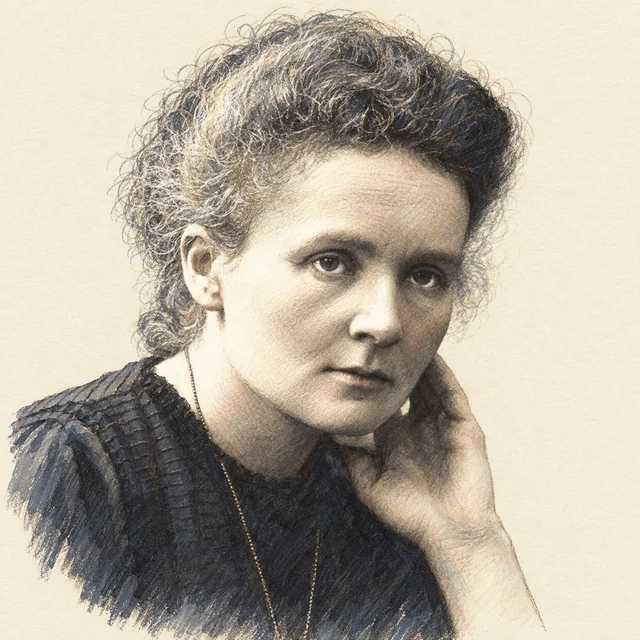
Illustrated portrait of Marie Curie

Marie Curie

Prize share · 1

Curie received the full 1911 Chemistry Prize for the discovery of radium and polonium, the isolation of radium and study of its nature and compounds. Her chemical separations and measurements established new elements; this differs from her shared 1903 Physics award for radiation research.

Read the biography ↗

03 · Years in the making

The path here

  1. 1891

    Marie Skłodowska moves to Paris to study.

  2. 1896

    Becquerel discovers uranium radiation.

  3. 1898

    Marie and Pierre announce polonium and radium.

  4. 1903

    Marie earns her doctorate and shares the Physics Prize.

  5. 1908

    She becomes a full professor at the Sorbonne.

  6. 1910

    Radium metal is isolated with Debierne’s help.

  7. 1911

    Marie receives the full Chemistry Prize.

04 · Read further

From the original sources

Original explanations by Curionode, based on the official records below. Biographical details and affiliations refer to the award year.

  1. Official award summary nobelprize.org
  2. Award ceremony speech nobelprize.org
  3. American Institute of Physics: Curie’s research after 1906 history.aip.org
  4. Musée Curie: the 1906 lecture and 1908 professorship musee.curie.fr

More in Chemistry

Browse this subject ↗