A life in context
The person behind the prize
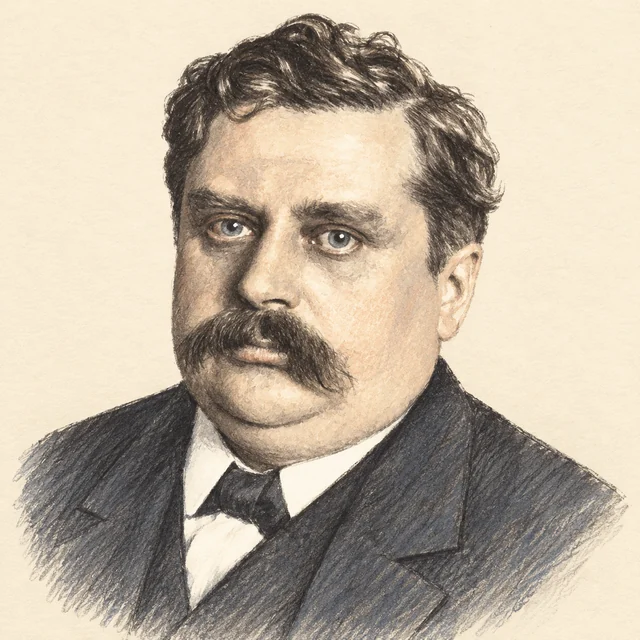
Alfred Werner was born in Mulhouse in Alsace and became interested in chemistry while still at school. Training in Karlsruhe and Zurich, work with Arthur Hantzsch and a period in Paris with Marcellin Berthelot brought him into questions about the spatial arrangement of atoms. His early research concerned nitrogen-containing molecules. In 1893 he published a theory of coordination compounds and joined the University of Zurich; he became a full professor in 1895 and also acquired Swiss citizenship. The theory addressed compounds that did not fit simple rules of valence. A metal centre could have a definite set of immediate coordinating partners arranged in space, with further ions outside that group. For many six-coordinate examples, an octahedral arrangement explained patterns that competing accounts could not. Werner and his collaborators prepared and compared series of compounds, testing predictions about different spatial arrangements and later optical isomers. These experiments were central to the achievement, alongside the theoretical proposal. Coordination chemistry also includes other numbers and shapes; six neighbours are not a universal rule. The 1913 Chemistry Prize recognised his work on atomic linkages and the fields it opened, especially in inorganic chemistry. His teaching and research remained based in Zurich. Ill health increasingly limited his work, and he died there in 1919.
The contribution
Werner received the full Chemistry Prize for a framework connecting atomic linkages, coordination numbers and spatial arrangement. His theory and his group’s experiments established a foundation for inorganic stereochemistry and coordination chemistry.
The idea in plain language
Werner’s 1893 coordination theory distinguished a central atom’s immediate coordination sphere from ions outside it. The number and arrangement of directly coordinating atoms mattered alongside the chemical composition. For many six-coordinate examples, an octahedral arrangement explained observed patterns. Other coordination numbers and shapes also occur.
Read the full award story ↗

