c.curionodeThe Nobel Archive

1913 · Chemistry

Give coordination compounds a spatial structure

Some metal compounds resisted simple explanations based on valence alone. Werner connected the immediate partners around a metal centre with a definite arrangement in three dimensions.

Coordination chemistryMolecular geometryIsomerism
1913Chemistry

Visual guide

The prize, pictured

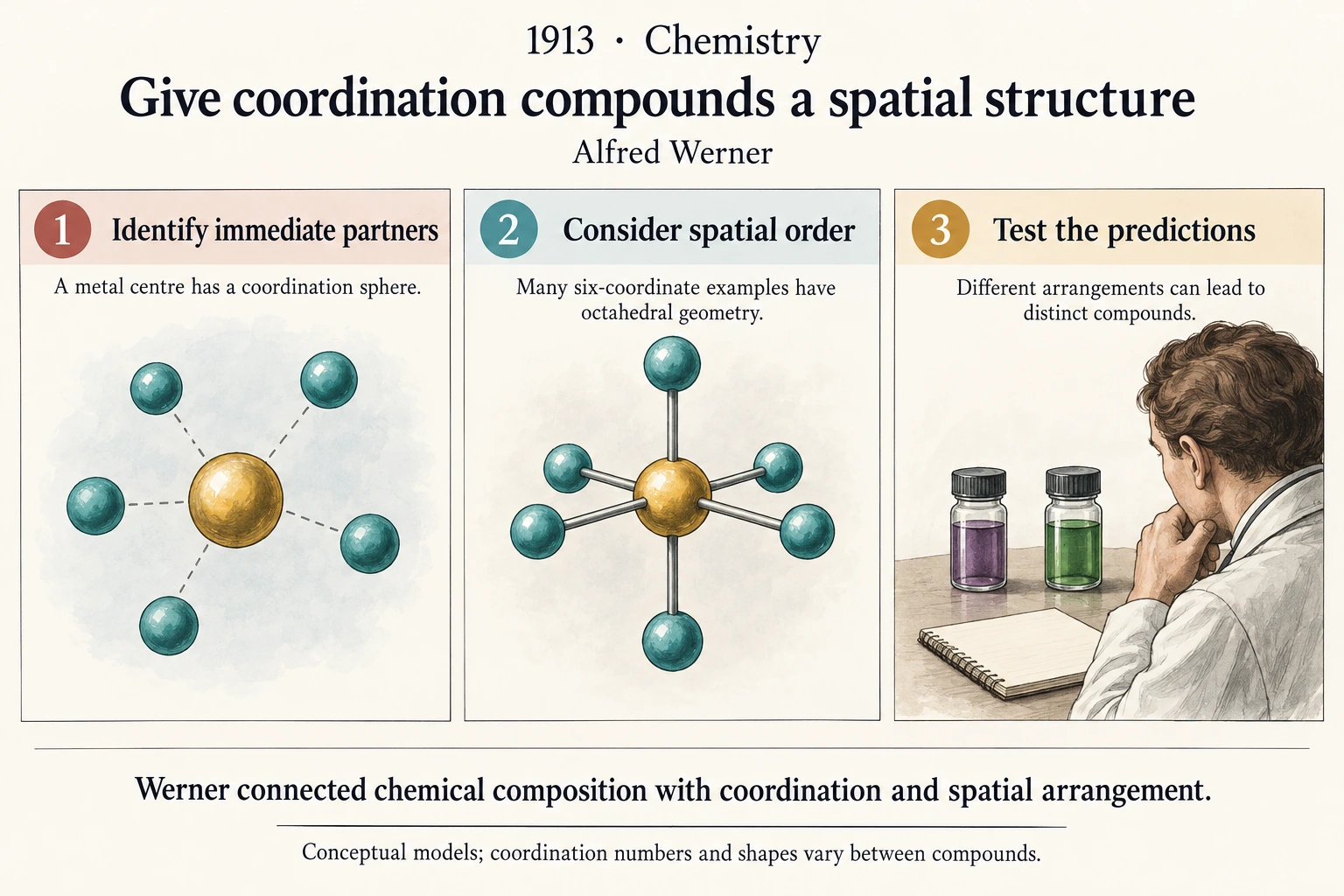
Infographic explaining Give coordination compounds a spatial structure
Original AI-generated infographic. A conceptual overview; the explanations and sources below provide context.
Read the poster text

Werner connected chemical composition with coordination and spatial arrangement.

  1. Identify immediate partners

    A metal centre has a coordination sphere.

  2. Consider spatial order

    Many six-coordinate examples have octahedral geometry.

  3. Test the predictions

    Different arrangements can lead to distinct compounds.

Conceptual models; coordination numbers and shapes vary between compounds.

01 · The discovery

The idea, in everyday language

Werner’s 1893 coordination theory distinguished a central atom’s immediate coordination sphere from ions outside it. The number and arrangement of directly coordinating atoms mattered alongside the chemical composition. For many six-coordinate examples, an octahedral arrangement explained observed patterns. Other coordination numbers and shapes also occur.

A proposed arrangement could predict which distinct compounds should be possible. Werner and his collaborators prepared and compared series of compounds to test those predictions, including cases of geometrical isomerism and optical isomers. Spatial chemistry was therefore an experimental framework as well as a way of drawing models. The 1913 prize recognised the new understanding of atomic linkages and the research fields it opened.

Why it matters

Coordination chemistry gave inorganic chemistry a framework for connecting composition, bonding and shape. It helped explain why related compounds could have different properties and made structural predictions available for chemical testing.
02 · The people

Who brought the idea to life?

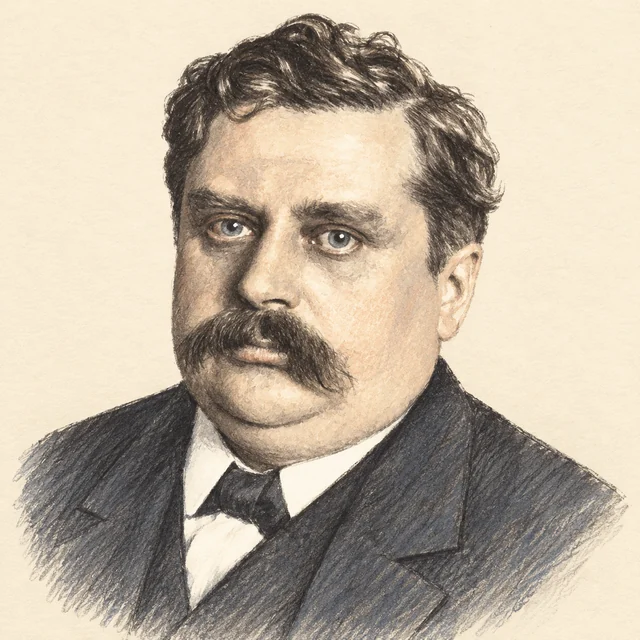
Illustrated portrait of Alfred Werner

Alfred Werner

Prize share · 1

Werner received the full Chemistry Prize for a framework connecting atomic linkages, coordination numbers and spatial arrangement. His theory and his group’s experiments established a foundation for inorganic stereochemistry and coordination chemistry.

Read the biography ↗

03 · Years in the making

The path here

  1. 1866

    Werner is born in Mulhouse.

  2. 1893

    He publishes his coordination theory and joins the University of Zurich.

  3. 1895

    He becomes a full professor and a Swiss citizen.

  4. 1913

    He receives the full Chemistry Prize.

  5. 1919

    He dies in Zurich.

04 · Read further

From the original sources

Original explanations by Curionode, based on the official records below. Biographical details and affiliations refer to the award year.

  1. Official award summary nobelprize.org
  2. Award ceremony speech nobelprize.org
  3. University of Zurich: Werner’s coordination theory uzh.ch

More in Chemistry

Browse this subject ↗