A life in context
The person behind the prize
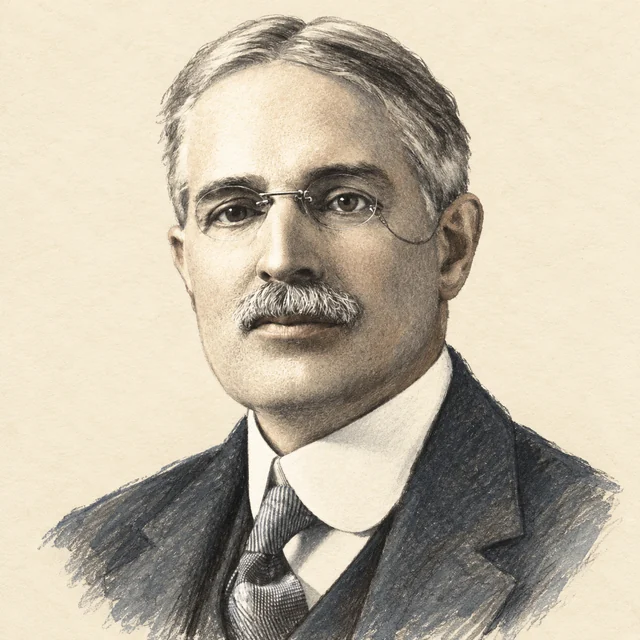
Theodore William Richards grew up in a family active in painting and poetry. Educated at home until his teens, he studied at Haverford College and then Harvard, receiving his doctorate in 1888. After a year of study in Germany, he returned to Harvard and developed a career in precise chemical measurement. He became a professor in 1901, department chair in 1903, and Erving Professor and director of the Wolcott Gibbs Memorial Laboratory in 1912. Work with Josiah Parsons Cooke and later with students and coworkers concentrated on determining relative atomic weights from carefully controlled chemical measurements. Richards showed that apparently precise weighing could conceal systematic errors from moisture, trapped substances, incomplete separation or contamination from vessels. Better purification, weighing conditions and cross-checks allowed many earlier values to be revised. His contribution combined improved methods with the determinations produced by his research group. He also investigated other physical and chemical properties and developed instruments for detecting small quantities of suspended material. The 1914 Chemistry Prize was reserved and announced on 11 November 1915. Harvard was his award affiliation. His broader career included work on calorimetry and service to scientific societies. He died in Cambridge, Massachusetts, in 1928.
The contribution
Richards received the full Chemistry Prize for accurate determinations of the atomic weights of many elements. He and his school improved the chemical methods and control of systematic errors that made those determinations reliable.
The idea in plain language
Chemists could infer relative atomic weights from the masses of substances entering or emerging from reactions with known composition. The difficulty was that a measured mass might include something unintended: retained water, trapped gases, contamination or material that had not been fully separated. Repeating the same biased procedure could yield impressively consistent values without making them correct.
Read the full award story ↗

