A life in context
The person behind the prize
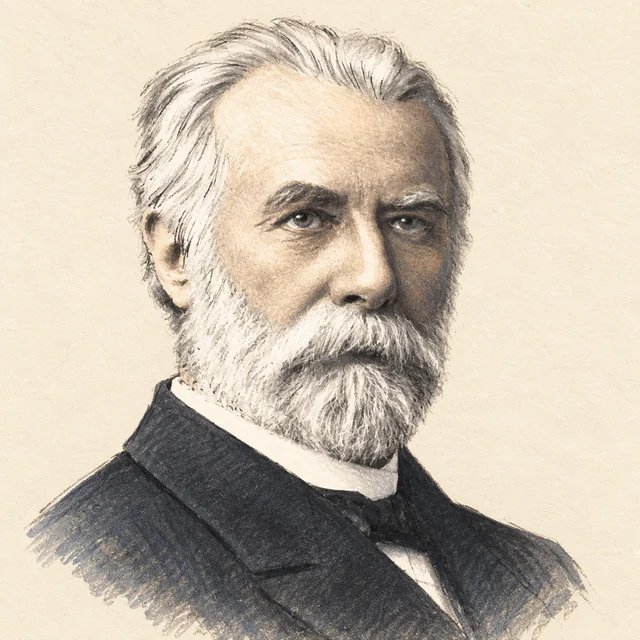
Fredrik Bajer was born in Vester Egede near Næstved and trained for a military career. He became a cavalry officer in 1856, served during the war of 1864 and left the army in 1865. In Copenhagen he worked as a teacher, translator and writer, developing an international outlook through language study and contact with peace advocates. His public work also involved women’s rights. In 1871 he helped establish the Danish Women’s Society with his wife Matilde and other founders; Matilde was its first leader, while Fredrik served as secretary and adviser. He sat in the Folketing from 1872 to 1895, seeking practical changes through parliamentary proposals. In 1882 he founded a society for Danish neutrality, later known as the Danish Peace Society, and promoted arbitration and Nordic cooperation. International congresses and the Inter-Parliamentary Union provided links across national organisations. Bajer proposed a permanent peace bureau, helped bring it into being in Bern in 1891 and became its first president. In 1907 he stepped down from that office and became honorary president. He shared the 1908 Peace Prize equally with Klas Pontus Arnoldson. Illness prevented him from attending the ceremony, and the Danish minister accepted his medal and diploma. His individual award should be distinguished from the bureau’s own Peace Prize in 1910. Bajer died in Copenhagen in 1922. His work showed how translation, correspondence, committees and regular meetings could sustain a movement between its public congresses, while neutrality and voluntary agreements still depended on the decisions of states.
The contribution
Bajer received half the Peace Prize for long work as a politician, peace-society leader, speaker and author. He connected national peace groups and helped establish the permanent international bureau that supported their cooperation.
The idea in plain language
Arnoldson helped build the Swedish peace movement, promoting neutrality and international arbitration. During tensions over the union with Norway he urged that peace should come before maintaining the union by force. Speaking, petitions and books carried these arguments beyond parliament, while the peaceful dissolution of 1905 depended on many actors.
Read the full award story ↗