A life in context
The person behind the prize
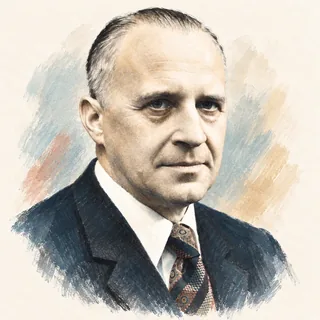
Wilkinson grew up near Todmorden and encountered chemistry through a family connection with a small chemical company. He graduated from Imperial College in 1941 and joined wartime nuclear research in Canada. At Berkeley, work with Glenn Seaborg explored radioactive isotopes. A move to MIT in 1950 revived his interest in transition-metal complexes. He joined Harvard in 1951, where the newly reported ferrocene prompted an independent explanation of its sandwich structure. Appointed to Imperial’s inorganic-chemistry chair in 1955, he took up the post in January 1956. Research with students and colleagues covered transition-metal compounds and homogeneous catalysis. His contribution helped show that carbon ring systems could bind a metal in ways missed by conventional structural pictures.
The contribution
Wilkinson independently explained sandwich structures and developed transition-metal complex chemistry. He received half the Chemistry Prize.
The idea in plain language
Other chemists had already prepared ferrocene. In 1952, Fischer and Wilkinson independently helped explain its surprising structure: an iron atom sits between two five-carbon cyclopentadienyl rings. The interaction involves each ring’s electron system, rather than two ordinary single bonds to isolated ring atoms. Its symmetry and stability challenged the first proposed structural picture.
Read the full award story ↗