A life in context
The person behind the prize
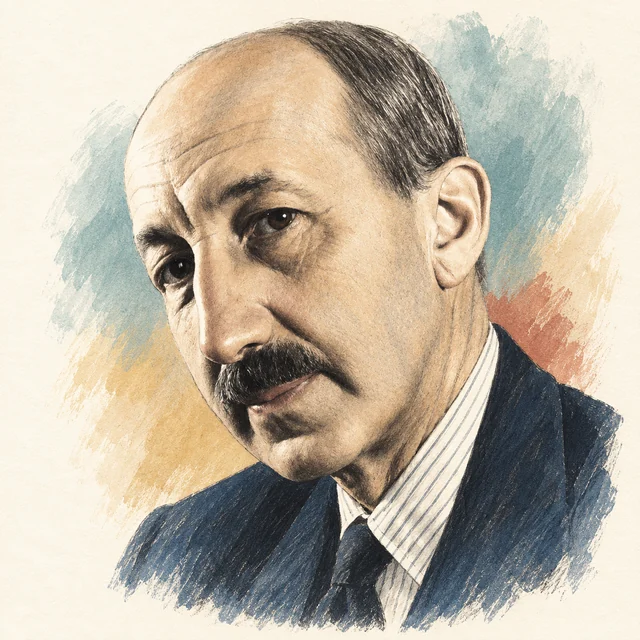
De Hevesy studied in Budapest, Berlin and Freiburg, receiving his doctorate at Freiburg in 1908. He worked in physical chemistry and joined Rutherford’s laboratory in Manchester in 1910. An unsuccessful attempt to separate radioactive lead from ordinary lead suggested a new possibility: an isotope that followed the same chemistry could reveal where the element went. In 1913 he and Frederic Paneth carried out an early radioactive-tracer experiment in Vienna. He later worked in Copenhagen, became professor at Freiburg in 1926 and returned to Copenhagen in 1934 after fleeing Nazism. In 1943 he moved to Stockholm. His research extended isotope tracing from inorganic chemistry into biological processes, while the availability of additional isotopes broadened what could be investigated. His 1923 discovery of hafnium with Dirk Coster was a separate achievement. The full 1943 Chemistry Prize recognised the use of isotopes as tracers, and was announced in November 1944 after being reserved. The historical name radium D in the early work refers to a lead isotope, not to an isotope of the element radium.
The contribution
De Hevesy received the whole Chemistry Prize for using isotopes as tracers to investigate chemical processes, including processes in living organisms.
The idea in plain language
How can researchers follow a small amount of an element when it mixes with a much larger amount of the same element? A difficulty in separation suggested an answer. Radioactive lead and ordinary lead were so similar chemically that attempts to separate them failed. An identifiable isotope could therefore accompany the element through a process instead of being removed from it.
Read the full award story ↗

