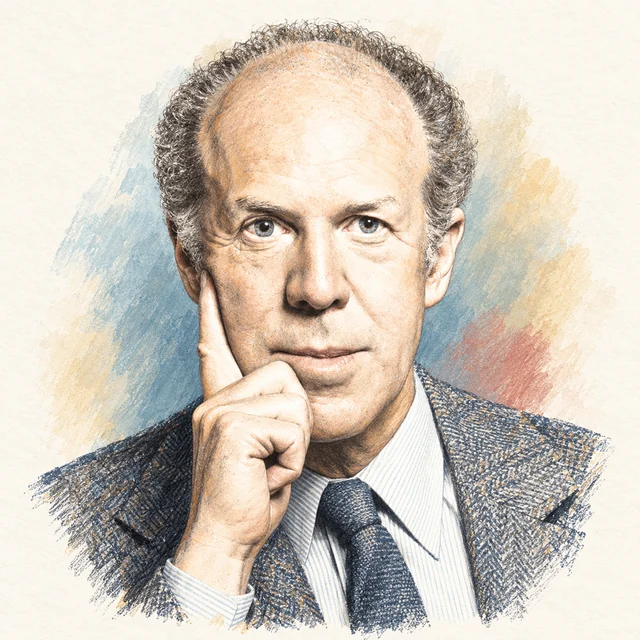
A life in context
The person behind the prize
Debreu studied mathematics at the École Normale Supérieure during the occupation of France, influenced by Henri Cartan and the Bourbaki approach. Military service interrupted his studies; afterward he turned to economics through Maurice Allais’s work. Research visits preceded his appointment at the Cowles Commission in Chicago in 1950. He moved with it to Yale in 1955 and published Theory of Value in 1959. His Berkeley appointment began in January 1962. With Kenneth Arrow he developed an existence proof for competitive equilibrium; collaboration with Herbert Scarf explored the core of an economy. Exact assumptions and rigorous argument were characteristic of his work.
The contribution
Debreu introduced powerful mathematical methods and reformulated general equilibrium as an axiomatic theory. Under specified conditions, individually chosen production and consumption plans can be compatible at a system of prices. His work made the assumptions and logical requirements explicit. An existence theorem does not by itself establish a unique outcome, explain how actual prices reach it, guarantee fairness or validate every market policy.
The idea in plain language
A household chooses what to buy within its budget; a firm chooses production and inputs. Each plan depends on prices, including wages. Because one person’s demand is another’s opportunity to supply, all markets must be considered together. Merely writing as many equations as unknowns does not prove that an economically admissible solution exists.
Read the full award story ↗