A life in context
The person behind the prize
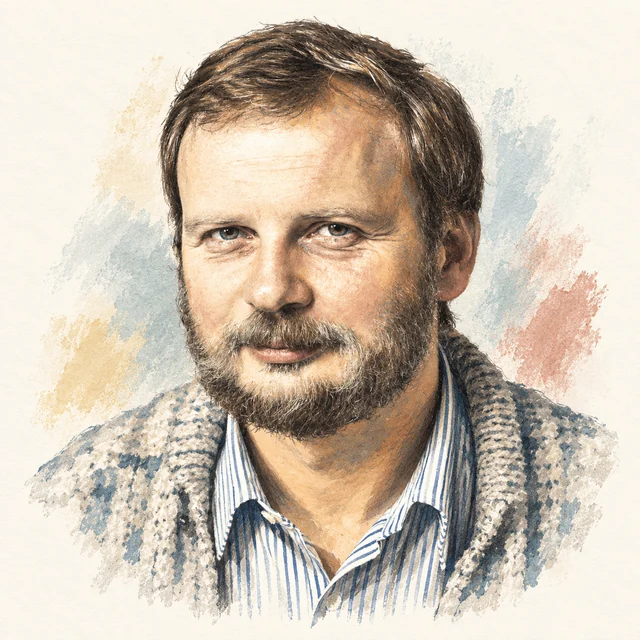
Michel grew up in a working family and became interested in biology, chemistry and physics through reading. He studied biochemistry at Tübingen and completed doctoral work with Dieter Oesterhelt in 1977. Membrane proteins were difficult to crystallise. Experiments with bacteriorhodopsin, including work with Richard Henderson, helped develop his approach. He obtained useful bacterial reaction-centre crystals in 1981 and collaborated with Deisenhofer and Huber on analysis. In October 1987 he became a director at the Max Planck Institute for Biophysics in Frankfurt.
The contribution
Michel isolated and crystallised the photosynthetic reaction centre from the purple bacterium historically called Rhodopseudomonas viridis. Useful crystals obtained in 1981, described in a 1982 paper, enabled X-ray structure determination. This reaction centre is distinct from bacteriorhodopsin and from a plant chloroplast. Michel received one third of the prize for the joint structural achievement.
The idea in plain language
A photosynthetic reaction centre begins conversion of absorbed light into separated charge. Its protein scaffold holds pigments and other cofactors in a particular arrangement. Membrane proteins were difficult to isolate and crystallise, making their structures hard to determine. Michel obtained useful crystals of a purple bacterium’s reaction centre in 1981 and reported them in 1982.
Read the full award story ↗