A life in context
The person behind the prize
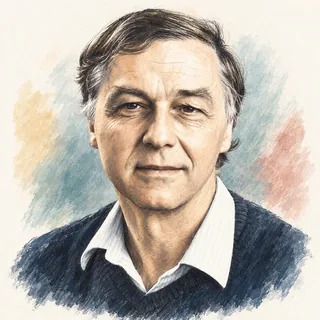
Deisenhofer grew up in a Bavarian farming family. Physics at the Technical University of Munich led from astronomy and solid-state interests toward biological structures. He joined Huber’s laboratory in 1971 and completed his doctorate in 1974, developing crystallographic methods and software. Joining the reaction-centre project in 1982, he worked closely with Kunio Miki and Otto Epp on the structure and its refinement. He moved to Dallas in March 1988, working at UT Southwestern and the Howard Hughes Medical Institute.
The contribution
Deisenhofer helped turn diffraction measurements into a three-dimensional model of a bacterial photosynthetic reaction centre. Combining data, computation and refinement with Miki, Epp, Huber and Michel revealed the arrangement of protein subunits and light-active cofactors. The major structure paper appeared in 1985. He received one third of the Chemistry Prize.
The idea in plain language
A photosynthetic reaction centre begins conversion of absorbed light into separated charge. Its protein scaffold holds pigments and other cofactors in a particular arrangement. Membrane proteins were difficult to isolate and crystallise, making their structures hard to determine. Michel obtained useful crystals of a purple bacterium’s reaction centre in 1981 and reported them in 1982.
Read the full award story ↗