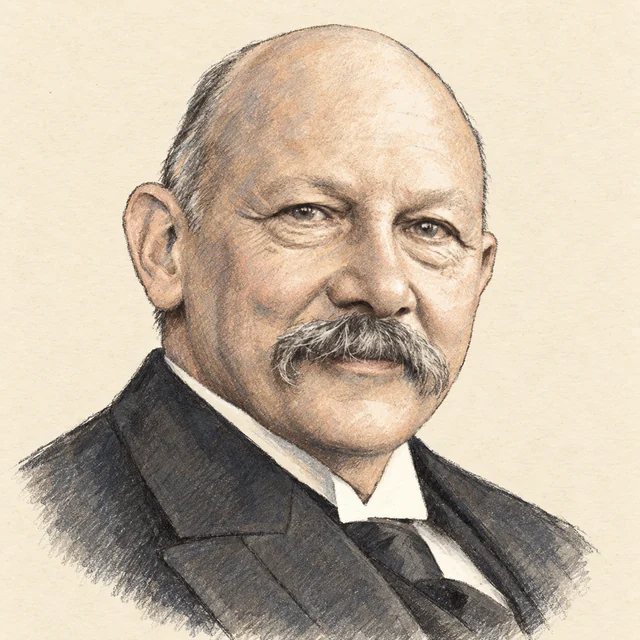
A life in context
The person behind the prize
Heike Kamerlingh Onnes studied in Groningen and Heidelberg, working with Robert Bunsen and Gustav Kirchhoff before earning his doctorate in Groningen in 1879. He worked in Delft and became professor of experimental physics and meteorology at Leiden in 1882. There he developed a laboratory programme centred on careful quantitative measurement of matter at low temperatures, drawing on the work of van der Waals and Lorentz. The programme required sustained work on instruments, gas handling and temperature measurement. The instrument makers and glassblowers trained in the school he founded in 1901 were part of that scientific infrastructure. In 1908 his laboratory first liquefied helium, opening a colder experimental range. In 1911, measurements of mercury revealed an abrupt disappearance of electrical resistance, the phenomenon named superconductivity. This happened two years before his 1913 Nobel award; one sentence in the Nobel facts biography wrongly places the discovery in the award year, while its work section and Leiden’s centenary account give 1911. The prize recognised a wider programme on the properties of matter at low temperatures, including liquid helium. These achievements depended on the laboratory’s researchers and skilled craftspeople as well as its director. After the First World War, he helped maintain international scientific contacts and supported relief for children. He died in Leiden in 1926.
The contribution
Kamerlingh Onnes received the full Physics Prize for low-temperature investigations, including the production of liquid helium. His laboratory made new temperature ranges accessible for systematic measurements of matter, including the discovery of superconductivity in 1911.
The idea in plain language
Changing temperature can change a material’s behaviour in ways that ordinary-temperature experiments do not reveal. Kamerlingh Onnes organised a sustained programme of accurate measurements of gases and liquids, informed by thermodynamics and the work of van der Waals. Reaching lower temperatures required improved instruments, skilled craft work and knowledge of the gases themselves.
Read the full award story ↗

