c.curionodeThe Nobel Archive

1913 · Physics

Open a colder range for studying matter

Kamerlingh Onnes built the methods and laboratory needed to investigate matter at very low temperatures. Liquid helium, first produced in his laboratory in 1908, made a new range of experiments possible.

Low temperaturesLiquid heliumSuperconductivity
1913Physics

Visual guide

The prize, pictured

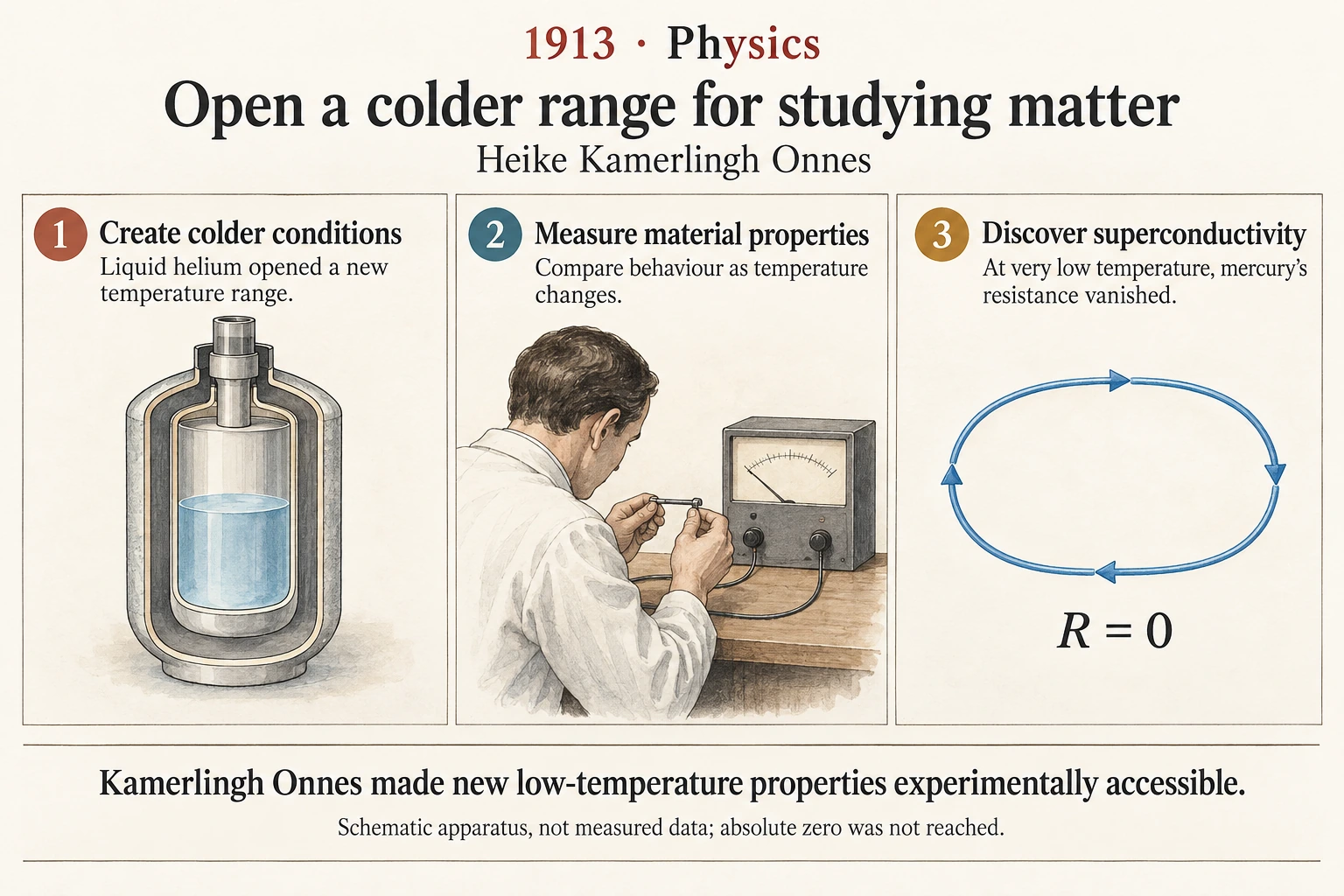
Infographic explaining Open a colder range for studying matter
Original AI-generated infographic. A conceptual overview; the explanations and sources below provide context.
Read the poster text

Kamerlingh Onnes made new low-temperature properties experimentally accessible.

  1. Create colder conditions

    Liquid helium opened a new temperature range.

  2. Measure material properties

    Compare behaviour as temperature changes.

  3. Discover superconductivity

    At very low temperature, mercury’s resistance vanished.

Schematic apparatus, not measured data; absolute zero was not reached.

01 · The discovery

The idea, in everyday language

Changing temperature can change a material’s behaviour in ways that ordinary-temperature experiments do not reveal. Kamerlingh Onnes organised a sustained programme of accurate measurements of gases and liquids, informed by thermodynamics and the work of van der Waals. Reaching lower temperatures required improved instruments, skilled craft work and knowledge of the gases themselves.

The production of liquid helium in 1908 provided a powerful means of cooling samples. In 1911, the laboratory found that mercury’s electrical resistance disappeared abruptly at sufficiently low temperature: superconductivity. The 1913 prize recognised the broader investigation of matter at low temperatures, including liquid helium. Superconductivity was one important discovery within that programme.

Why it matters

Cryogenic research made new properties accessible and gave theories of matter demanding tests. Superconductivity later became important for strong magnets and many kinds of research. Those later applications grew from further work; the 1913 award concerned the experimental opening of a low-temperature field.
02 · The people

Who brought the idea to life?

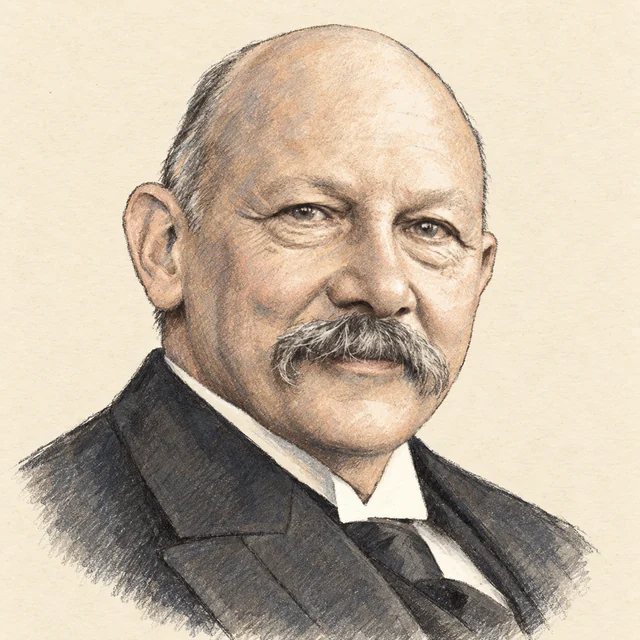
Illustrated portrait of Heike Kamerlingh Onnes

Heike Kamerlingh Onnes

Prize share · 1

Kamerlingh Onnes received the full Physics Prize for low-temperature investigations, including the production of liquid helium. His laboratory made new temperature ranges accessible for systematic measurements of matter, including the discovery of superconductivity in 1911.

Read the biography ↗

03 · Years in the making

The path here

  1. 1853

    Kamerlingh Onnes is born in Groningen.

  2. 1882

    He becomes a professor at Leiden.

  3. 1901

    His laboratory’s school for instrument makers and glassblowers is founded.

  4. 1908

    The laboratory first liquefies helium.

  5. 1911

    Mercury is found to become superconducting.

  6. 1913

    He receives the full Physics Prize.

04 · Read further

From the original sources

Original explanations by Curionode, based on the official records below. Biographical details and affiliations refer to the award year.

  1. Official award summary nobelprize.org
  2. Award ceremony speech nobelprize.org
  3. Leiden University: the 1911 superconductivity discovery web.universiteitleiden.nl
  4. Leiden University: the instrument makers school top450.universiteitleiden.nl